


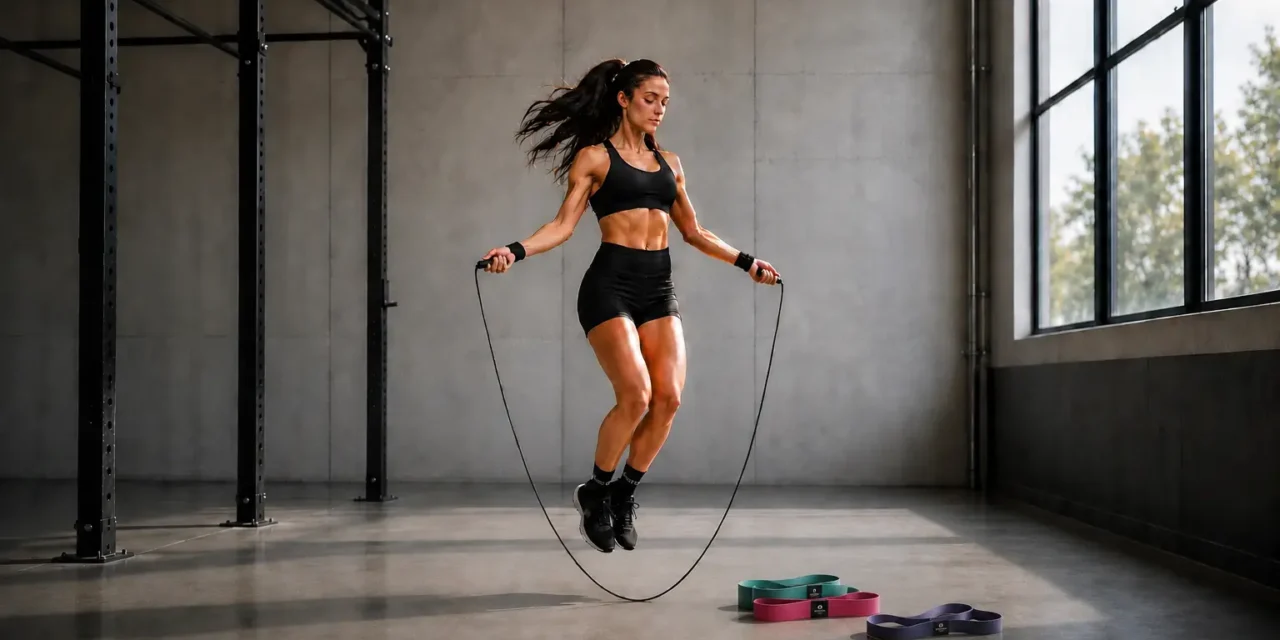
The Smallest Tools Often Create the Biggest Difference
There’s a strange moment that many runners eventually experience. They increase mileage, add intervals, buy better shoes and start tracking heart rate more obsessively — yet somehow, running still feels heavy.
Not necessarily harder from a cardiovascular perspective, but mechanically heavier. The stride starts losing rhythm under fatigue, ground contact becomes louder, cadence slows slightly without even noticing and a pace that once felt controlled suddenly starts feeling expensive.
And usually, the problem is no longer aerobic fitness.
It’s mechanics.
This is where some of the simplest tools in training become surprisingly powerful: resistance bands and the jump rope. Not because they replace running, and not because they are “magic exercises,” but because they improve the systems underneath efficient movement — reactivity, stiffness, coordination, posture, tendon resilience and force transfer.
Most runners don’t think about these things until fatigue finally exposes them.
Running Is More Elastic Than Most People Realize
Every running stride is essentially an elastic event. You land, absorb force, store elastic energy and reuse it again — thousands of times over the course of a single session. The better the body manages that cycle, the cheaper running becomes metabolically, which is one of the main reasons why two athletes with similar aerobic fitness can still move at completely different efficiency levels.
Modern endurance research increasingly supports this idea. Running performance is not determined only by VO₂ max or cardiovascular capacity, but also by running economy — how efficiently the body uses energy at a given pace. Reactive strength, tendon stiffness and neuromuscular coordination all influence this far more than most runners initially realize.
That’s exactly why tools like jump rope and resistance bands transfer so effectively into endurance and hybrid performance. They help improve how the body absorbs, controls and redirects force under fatigue, which ultimately allows athletes to maintain rhythm, posture and efficiency for longer once running starts becoming mechanically demanding.
Why Jump Rope Improves Running More Than People Expect
Most people still see jump rope as conditioning, but that’s only a small part of what it actually does. The real value lies in what happens at ground contact.
Every rope bounce teaches the body to become more reactive and less wasteful. The ankle learns stiffness, the foot learns rhythm and the lower leg becomes faster at absorbing and returning force efficiently. Studies on jump rope training in endurance athletes have shown improvements in lower-limb reactivity and running performance, particularly through better foot-arch stiffness and elastic efficiency.
This matters enormously in hybrid sports and endurance racing because fatigue usually attacks elasticity first. That’s why many athletes start “muscling” their running late in races: they no longer rebound efficiently from the ground, stride mechanics begin collapsing subtly and pace starts costing more energy than it should.
Jump rope helps delay that breakdown — not through exhaustion, but through reactivity.
And unlike heavy plyometric work, it develops these qualities with relatively low impact and extremely high repeatability, making it one of the simplest ways to improve running rhythm, elasticity and coordination without adding excessive fatigue to an already demanding training load.
The Role of Tendon Stiffness
The word “stiffness” often sounds negative, but in running, controlled stiffness is actually what creates efficiency.
Elite runners behave almost like springs. Their tendons absorb force and return it rapidly with minimal wasted movement, allowing the body to become elastic instead of muscularly heavy. That doesn’t mean rigid — it means reactive.
Jump rope naturally develops this quality because of the repetitive elastic contacts through the ankle complex and foot. This becomes especially useful in hybrid racing, HYROX, trail running and longer threshold efforts, where fatigue tends to attack rhythm and elasticity before anything else.
And usually, the athlete who maintains rhythm the longest is also the athlete who maintains pace the longest.
Resistance Bands: The Missing Layer for Many Runners
If jump rope improves reactivity, resistance bands improve control.
Running is essentially controlled single-leg instability repeated endlessly, yet many runners only train linearly: forward movement, forward loading and forward fatigue. Resistance bands introduce lateral control, rotational stability and postural awareness — qualities that become increasingly important once fatigue starts accumulating.
Most running breakdowns are subtle. Knees begin drifting inward, hips start dropping, the pelvis loses stability, stride mechanics shorten and posture slowly collapses under fatigue. These are rarely dramatic failures, but rather small mechanical leaks repeated thousands of times until they eventually become slower pacing, higher energy cost and, in many cases, injury.
Band work helps reduce those leaks by improving stability, control and movement efficiency under fatigue.
Why Hip Stability Matters More Than People Think
The hips are some of the body’s biggest energy managers during running, yet they are also one of the most overlooked areas when athletes think about performance and fatigue. Poor hip stability creates unnecessary movement, and unnecessary movement almost always becomes wasted energy once fatigue starts accumulating.
That’s where band work becomes extremely valuable. Exercises focused on glute activation, pelvic control, knee tracking, stride consistency and single-leg coordination help the body stay mechanically organized for longer, especially during compromised or high-fatigue efforts.
This becomes particularly important for HYROX athletes, trail runners, runners returning from injury and endurance athletes training under consistently heavy loads, where maintaining posture and control late into sessions can completely change how efficiently the body continues moving.
What many runners describe as “dead legs” late in training is often not only cardiovascular fatigue, but also mechanical fatigue — the moment where the body slowly stops stabilizing efficiently and movement starts becoming progressively more expensive.
The Goal Is Not Exhaustion
This is where many athletes misuse these tools. They turn rope work into conditioning punishment or overload band exercises until they become sloppy strength circuits, but that completely misses the point.
The goal is not fatigue. The goal is efficiency.
Bands and jump rope work best as neural primers, movement-quality sessions, warm-up integration, recovery-day exposures or pre-run activation. The adaptations do not come from destroying the body, but from exposing it consistently to better rhythm, coordination and mechanical control under moderate stress.
Small exposures, repeated consistently — that’s where the real transfer happens.
How to Apply This in Training
One of the biggest mistakes athletes make is trying to build entire workouts around these tools, when in reality they tend to work best integrated into an already structured running plan.
A hybrid athlete preparing for HYROX, for example, could benefit enormously from short rope-based reactivity work before threshold or compromised running sessions, while a trail runner might use band circuits before aerobic runs to improve hip engagement, posture and stability once fatigue starts accumulating.
And from a hybrid athlete perspective, this is where the work becomes powerful: not in the moments where everything feels fresh, but in the moments where the body starts looking for shortcuts and mechanics ultimately decide whether you keep moving efficiently or begin fighting every step.
The application itself stays relatively simple, but consistency is what creates the adaptation.
Running Reactivity & Stability Session
A 30-Minute Session for Better Running Mechanics
This session is not designed to exhaust you, but to improve how you move under fatigue by developing better rhythm, stiffness, posture, coordination and force transfer. The goal is simple: to make running feel lighter, cleaner and more reactive over time.
It works especially well on recovery days, before easy aerobic runs, after strength sessions or 1–2 times weekly alongside hybrid training, where the objective is not adding more fatigue, but reinforcing efficient movement patterns while the body is under moderate stress.
You should finish feeling activated, mechanically sharp and more reactive rather than completely drained.
Reactive Rope Block — 8 Minutes
Purpose: improve ankle stiffness, cadence rhythm and elastic ground contact.
4 rounds:
- 60 sec light jump rope
- 20 sec fast cadence
- 20 sec single-leg bounce left
- 20 sec single-leg bounce right
- 40 sec easy recovery
Focus on quiet contacts, minimal vertical movement, relaxed shoulders and fast elastic rebound. The rope should feel rhythmic, not aggressive.
Band Stability Flow — 10 Minutes
Purpose: improve hip stability and running control under fatigue.
2–3 rounds:
- Lateral band walks × 15 each side
- Banded glute bridge × 15
- Standing hip drive × 12 each side
- Single-leg RDL with band tension × 10
- Dead bug band press × 10 each side
- Slow calf raises × 15
Move continuously without rushing. The objective is not muscular failure. It is movement quality.
Elastic Running Circuit — 10–12 Minutes
Purpose: integrate reactivity, posture and coordination into running-specific movement.
3–4 rounds:
- 30 sec jump rope
- 10 pogo jumps
- 15 m A-skips
- 15 m high-knee rhythm run
- 10 band squat pulses
- 200 m relaxed run
- 60 sec walk recovery
Focus on upright posture, elastic rhythm, controlled breathing and a relaxed foot strike. This should feel athletic and reactive — not heavy.
Why Sessions Like This Matter
Most runners focus only on training harder, but better runners eventually learn how to move better under fatigue.
In hybrid racing, mechanics are performance. Once posture, rhythm and reactivity begin disappearing, pace becomes expensive very quickly. That’s why tools like resistance bands and jump rope transfer far more than people expect: over time, they improve rhythm, coordination, stiffness, posture, efficiency and overall running economy.
And eventually, running simply starts to feel lighter, cleaner and more controlled under fatigue.
For us, this is also part of a much bigger process — learning how to carry strength into endurance, how to keep movement clean once fatigue appears, and how to build a body that doesn’t just survive long efforts, but continues responding efficiently inside them.
Backyard Ultra Giveaway
As part of our preparation for the upcoming Backyard Ultra, we’ll also be giving away two of the tools we genuinely use every week in training: a resistance band and a jump rope.
Not because they’re complicated, but because small improvements in rhythm, control and mechanics tend to create the biggest difference once fatigue appears.
We’ll also be documenting the full preparation process on Instagram — training, fatigue management, hybrid-to-ultra transition, testing sessions and real race preparation as we move closer to the Backyard Ultra.
Follow the process with us on @team.baddazz.
Small tools. Massive transfer.
Be Bold. Be Baddazz 🖤