

Most kids don’t need more plans.
They need something that actually engages them.
Not another screen.
Not another easy option.
Not another “maybe next time.”
They need to feel involved.
That’s where HYBRID RUN comes in.
On May 9th in Torremolinos, this is not just another event on the calendar. It’s an opportunity to step into something more engaging together. Not as spectators, not as support from the outside, but as participants in an experience built for you and your kids to share.
The introduction of the Kids category and the Parent–Child format isn’t just an extra feature. It’s a shift in how sport can be approached. Instead of separating adults and children into different environments, it brings them into the same space—adapted, accessible, but still meaningful.
You don’t just take your kids to watch you compete.
You share the moment.
And that changes everything.
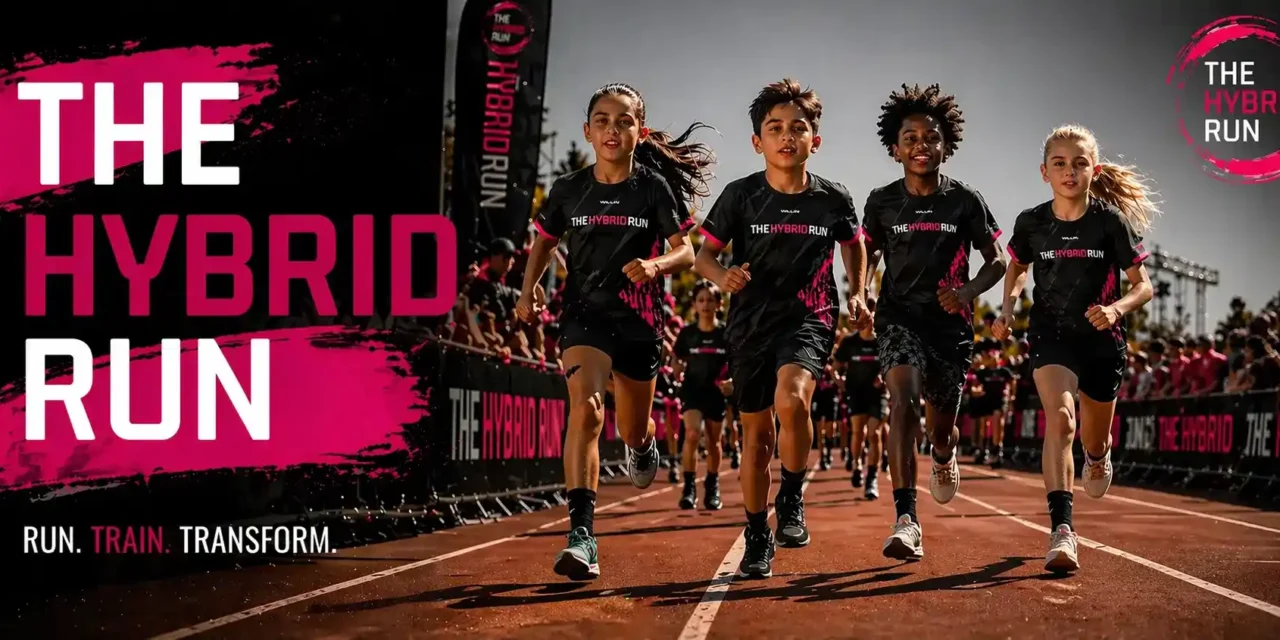
What makes HYBRID RUN different is that it keeps its identity intact. This isn’t a passive activity or a simplified introduction with no substance. The event is built around a hybrid format—running combined with functional stations, transitions, and continuous movement.
→ If you want a closer look at how it all comes together, you can explore the format here:
Explore the HYBRID RUN format
It challenges coordination, rhythm, and effort, and even in its adapted version, that structure remains.
You arrive at the venue and immediately notice the atmosphere: movement, people preparing, a sense that something is about to begin. Then comes the part that defines the experience—you and your child step into it together.
You start side by side.
You move through the course, alternating between running and stations designed to be achievable but engaging. There’s effort, but also moments of adjustment and interaction. It’s not about doing everything perfectly. It’s about staying involved from start to finish.
And when you cross that finish line, it doesn’t feel like just another completed activity.
It lands differently.
Because kids don’t retain schedules or instructions in the same way adults do. What stays with them are the moments where they felt capable, where they tried something new, and where they were part of something outside their usual routine.
Most importantly, they remember who was next to them when it happened.
That’s the real value behind this category.
At the same time, one of the biggest barriers for families when it comes to events like this is the assumption that they need to be “ready”—that it requires a certain level of fitness, preparation, or experience.
HYBRID RUN removes that pressure.
The Kids and Parent–Child formats are designed to be accessible and safe, without losing the sense of challenge that makes the experience worthwhile. You don’t need to be an athlete. Your child doesn’t need months of preparation. This isn’t about performance metrics or perfect execution.
It’s about showing up and trying something outside the usual routine.
About stepping slightly beyond what feels familiar in a way that is engaging, not overwhelming.
For many parents, this is exactly the kind of experience that finally makes sense.
And this is where the Kids category becomes especially relevant.
Because for them, it’s not about “joining an event.” It’s about being part of something that feels active, structured, and different from what they usually do.
There’s movement, noise, people getting ready, a clear start line. It doesn’t feel like another activity you drop them into—it feels like something is happening, and they’re part of it.
They line up.
They go.
They run, move through stations, and figure things out as they go. Not perfectly, but fully engaged. They’re not waiting for constant instruction, and they’re not on the sidelines. They’re participating.
And that’s where the difference becomes clear.
Most kids’ activities are either too structured or too passive. This sits in between. It gives direction, but also space to react, to move, and to stay involved.
They get slightly tired.
They adjust.
They keep going.
And by the end, they’ve completed something with a clear start, a process, and a finish—not just another exercise or game.
That’s usually enough.
You don’t need to explain it or turn it into a lesson. They leave knowing they did it.
And that stays with them.
At the same time, it’s not overwhelming. The format is adapted so they can move through it at their level, with the right balance between challenge and control. It’s structured, safe, and designed to keep them engaged from beginning to end.
That’s why it works.
For many kids, this will be their first exposure to something like this—an event that feels structured and active, but still accessible enough to enjoy.
And those first experiences tend to influence how they approach the next one.
So instead of another plan that fills a few hours, you give them something that stands out. Not because it was extreme or difficult, but because it felt different from what they usually do.
Something they talk about after—and ask to do again.
That’s the shift.
May 9th in Torremolinos isn’t just another kids activity. It’s a structured, active experience they get to be part of.
Spots are limited. And once it’s full, this experience is gone.
Not something to watch.
Something to share.
Be bold.
Be BADDAZZ 🖤.