

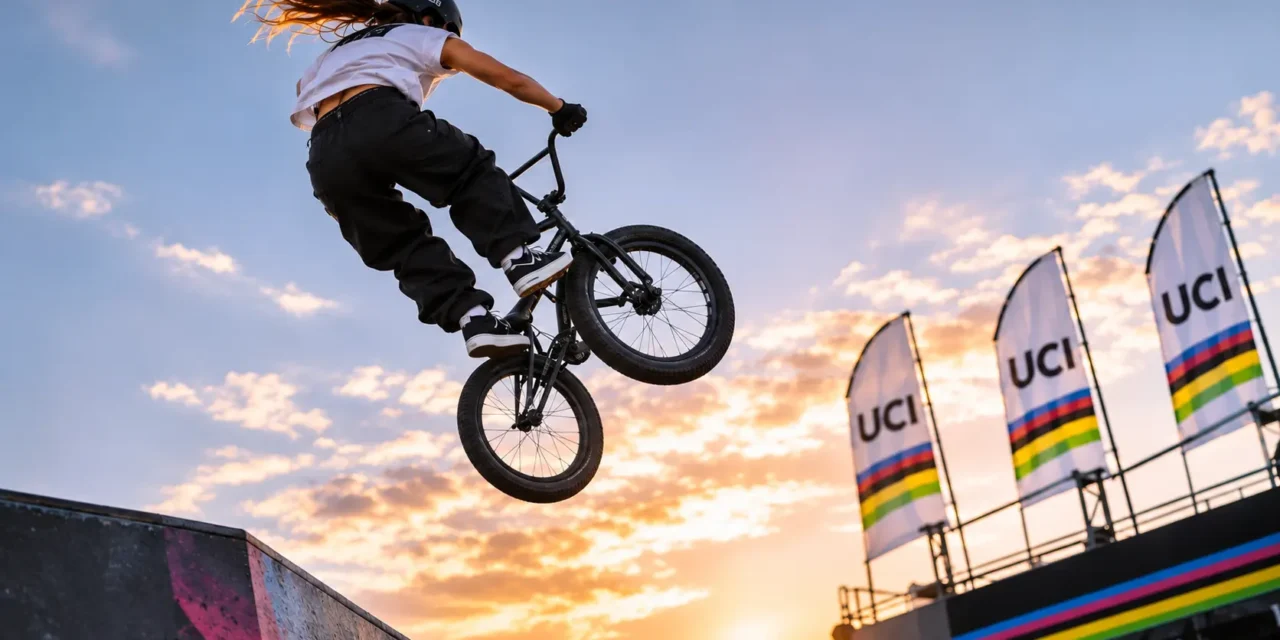
Sun Sibei will remain the women’s BMX Freestyle Park world champion until 2027, although she will not have the opportunity to defend her title this year. The Chinese rider won the 2025 world championship in Riyadh with 95.86 points, finishing ahead of compatriots Sun Jiaqi and Fan Xiaotong, but the cancellation of the 2026 UCI Urban Cycling World Championships means there will be no new world champion this season. Under UCI regulations, the reigning titleholders retain their status until the next championships, leaving Sun Sibei in possession of the rainbow jersey without another world championship victory being added to her record. She remains the legitimate world champion because she won the last championship that took place, not because she successfully defended her title in 2026.
The official results from the 2025 women’s final underline how competitive the battle for the title had been. Sun Sibei’s winning score of 95.86 put her 2.78 points ahead of Sun Jiaqi, who earned silver with 93.08, while Fan Xiaotong completed a Chinese podium sweep with 92.10. Those results established a clear winner in Riyadh, but they could not determine how the same riders might perform twelve months later. For Sun Sibei, the cancellation preserves a title she earned through competition; for her rivals, it removes an opportunity to challenge for the most prestigious distinction in their discipline. Neither consequence should be confused with an actual sporting result from 2026.
A World Championship Cancelled, but the Rivalry Continues
The 2026 UCI Urban Cycling World Championships had been scheduled for November 3 to 7 in Riyadh, bringing together athletes from BMX Freestyle Park, BMX Freestyle Flatland and trials. On October 16, however, the UCI and Saudi Cycling Federation announced that the event would not proceed, citing regional developments and their impact on the organisation of the championships. The decision affected multiple disciplines and categories, rather than specifically targeting women’s BMX Freestyle Park, and the organisers’ statement did not establish a more detailed cause. Its sporting consequences were nevertheless significant because athletes lost a scheduled world championship opportunity at a time when competition among the leading women remained active.
Just two days after the cancellation was announced, Sun Sibei demonstrated that her position at the top of the sport was supported by current results as well as her existing title. At the October 18 BMX Freestyle Park World Cup final in Shanghai, she finished first ahead of Sun Jiaqi, with Australia’s Natalya Diehm taking third place, according to the published Shanghai results report. The top two positions mirrored the previous year’s world championship, providing another indication of the strength of China’s leading riders while also placing an Australian contender on the podium. Shanghai was a meaningful victory for Sun Sibei and evidence that she continued to beat elite opposition, although a World Cup result cannot establish what would have happened at a different competition with its own conditions, participants and performances.
That distinction is particularly important because the cancellation could otherwise create a misleading impression of the champion’s status. Sun Sibei has not been awarded a second world title, nor has she benefited from an assumed victory over opponents who were never given the chance to compete for it. Equally, there is no evidence that she needed the cancellation to retain her position at the top of the discipline. Her Shanghai performance supports the opposite conclusion: she remained highly competitive and capable of winning major events. The unanswered question concerns the specific world championship that was removed from the calendar, not whether Sun Sibei was still performing at an elite level. The available reporting also does not establish her personal reaction to the cancellation, and comments she made about competing before a home crowd in Shanghai should not be presented as an assessment of the lost championship.
Why the Rainbow Jersey Stays With Sun Sibei
In its October 19 explanation of the sporting consequences, the UCI confirmed that regulation 1.3.063 would apply, allowing existing world champions to retain their titles and continue wearing the rainbow jersey in the same discipline, speciality and category until the eve of the next championships in 2027. For Sun Sibei, this applies specifically to women’s BMX Freestyle Park and does not constitute an additional championship victory or a title covering other BMX disciplines. Her 95.86-point performance in 2025 remains the result that earned her the rainbow jersey, while the absence of a 2026 competition means no new winner can replace her through the normal championship process.
The regulation provides continuity in circumstances where a new champion cannot be determined, but its consequences are not identical for the reigning champion and the rest of the field. Sun Sibei keeps an existing distinction, whereas riders such as Sun Jiaqi, Fan Xiaotong and Natalya Diehm lose a chance to compete for it. This does not make the rule inherently unfair, and the cancellation was not a decision made by Sun Sibei herself. It does, however, illustrate why descriptions of an extended championship reign need to distinguish between titles earned through competition and titles retained because the scheduled competition did not take place. The rainbow jersey remains with its rightful holder, but the sporting question of who would have won the 2026 championship has no answer.
The cancellation also carries consequences beyond the world title because Riyadh was intended to provide the first opportunity for BMX Freestyle Park athletes to earn qualification points towards the Los Angeles 2028 Olympic Games. According to the UCI, removing the event from the calendar required an adaptation of the Olympic qualification pathway, with the organisation working alongside the International Olympic Committee and further information promised for November. The October announcement establishes that a planned points-scoring opportunity was lost, but it does not identify the replacement mechanism or determine how individual riders’ Olympic prospects will ultimately be affected. Those details require confirmation through the relevant qualification rules and any subsequent UCI updates.
For athletes preparing for LA28, the distinction between a missed opportunity and a measurable qualification disadvantage is important. Competition schedules influence training, event selection and the opportunities available to accumulate ranking or qualification points, but no athlete can be assigned points from an event that never happened. It would therefore be speculative to claim that the cancellation cost Sun Jiaqi, Diehm, Fan or Sun Sibei a particular Olympic position. An adapted pathway may provide alternative opportunities to qualify, although it cannot retrospectively recreate the missing world championship or establish the results that might have been achieved in Riyadh.
A Champion’s Status Remains, but a Sporting Opportunity Is Lost
The 2025 world championship and the October 2026 Shanghai World Cup together demonstrate the competitive strength of women’s BMX Freestyle Park, particularly among China’s leading riders. Sun Sibei earned her rainbow jersey with a convincing performance in Riyadh and subsequently reinforced her standing by winning in Shanghai, while Sun Jiaqi’s repeated second-place finishes illustrated the consistency of a close rival. Natalya Diehm’s Shanghai podium also showed that the leading field extended beyond the Chinese team, making the cancelled world championship a missed opportunity for an international contest rather than merely a postponed meeting between two athletes.
For Sun Sibei, the record remains clear: she won the 2025 world championship and the October 2026 Shanghai World Cup, while retaining her world champion status under UCI regulations because the next championship was cancelled. Her rivals retain their own achievements but lose the opportunity to contest the rainbow jersey in 2026, and the Olympic qualification process must account for the removal of a planned points-scoring event. These are separate consequences of the same cancellation, each deserving an accurate description without speculation about results that never existed.
When the world championships return in 2027, the rainbow jersey will once again be decided through competition. Until then, Sun Sibei remains the reigning champion on the strength of the title she earned in 2025, supported by a subsequent World Cup victory that confirms her continuing competitive form. Her championship is not in question. What remains unresolved is whether she would have kept it if the 2026 world championship had taken place.