

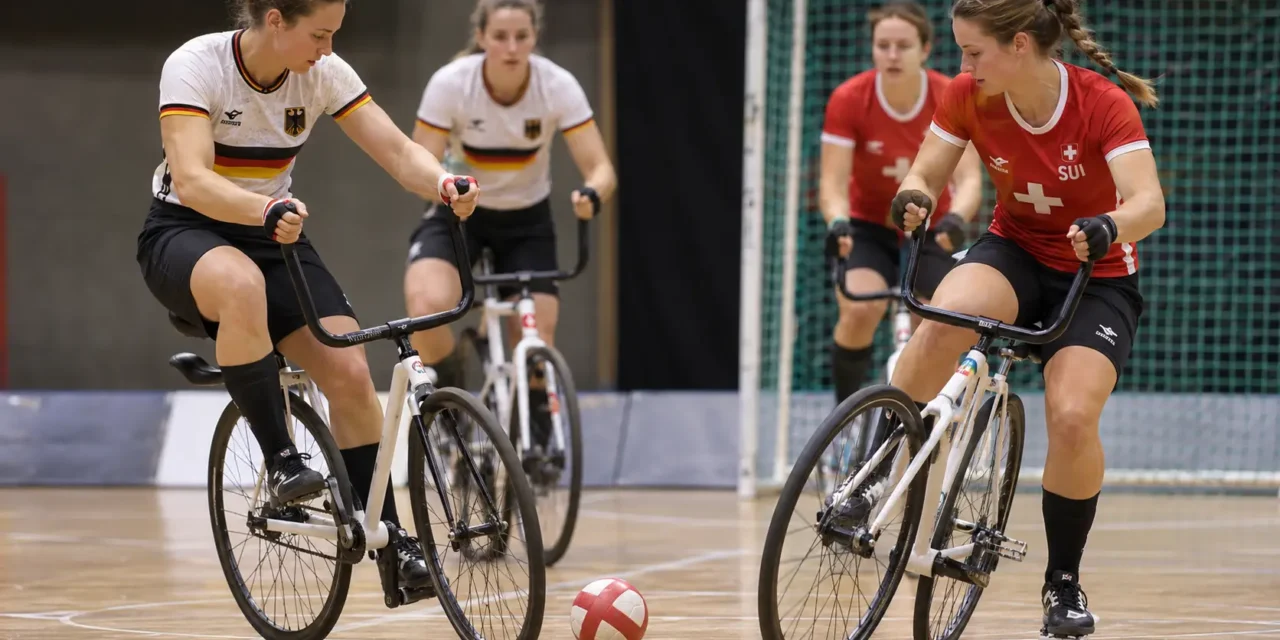
Germany’s Judith Wolf and Danielle Holzer have beaten Switzerland’s Sava Baumann and Chiara Dotoli in two major finals within weeks. First came a 4–1 victory at the Women’s Cycle-ball World Cup in Prechtal in October. Then a commanding 4–0 win at the 2026 UCI Indoor Cycling World Championships. Two finals, the same opponents, the same winners. For a sport whose women’s World Cup is only in its inaugural season, a compelling international rivalry is already emerging.
On November 21, the competition moves to Mosnang, Switzerland, where five women’s teams, two Swiss and three German, are scheduled to compete from 11 a.m. Whether the two championship finalist pairings will meet again remains unconfirmed. Yet the tournament represents something bigger than a potential rematch. For the first time in cycle-ball’s long history, women have a World Cup calendar of their own, offering international competition beyond the annual world championships.
The milestone is particularly striking when viewed against the sport’s history. Cycle-ball has been part of the world championship programme since 1930, but women did not compete for their first world title until 2023. That is a 93-year gap between the men’s championship tradition and the introduction of an equivalent women’s title. Now, just three years later, the women’s game has taken another significant step towards a more established international competitive structure.
Football on Two Wheels: What Makes Cycle-Ball Different?
Cycle-ball is one of cycling’s most unusual disciplines. Played by two-person teams on specially designed bicycles, it combines the tactical demands of football with extraordinary balance, precision and bike-handling skills. Players control, pass and shoot the ball primarily with their bicycle wheels, while their heads can also be used. According to the UCI’s official explanation of the sport, only the goalkeeper is permitted to handle the ball, and only within the penalty area.
What looks deceptively simple becomes remarkably demanding in practice. Players must maintain control of their bicycles while anticipating opponents’ movements, creating shooting angles and reacting to a fast-moving ball. Unlike conventional football, every attacking opportunity depends not only on positioning but also on bringing the bicycle into exactly the right position to execute a pass or shot. With only two players per team, there is little room for error. Communication, coordination and trust between partners are essential.
The recent encounters between Germany and Switzerland illustrate how quickly a competitive narrative can develop around the discipline. At the World Cup tournament in Prechtal on October 10, Wolf and Holzer defeated Baumann and Dotoli 4–1. The German partnership subsequently repeated its success at the world championships, winning the final 4–0, as confirmed by the UCI.
Eight German goals against one Swiss goal across two finals suggest a clear advantage in those encounters. But the significance extends beyond the scorelines. Both partnerships have reached the decisive stages of major international competitions, creating the possibility of a rivalry that can develop across multiple tournaments rather than being confined to a single championship. For Baumann and Dotoli, another meeting would offer the chance to challenge Germany’s recent dominance. For Wolf and Holzer, it would provide another opportunity to demonstrate why they currently hold the world title.
93 Years Without a Women’s World Championship
The introduction of women’s cycle-ball to the UCI World Championships in 2023 was a historic moment, although one that also exposed how long the discipline had operated without an equivalent championship opportunity for female athletes. Germany’s Nadine Jacqueline Weber and Claire Feyler became the first women’s world champions, defeating Japan 3–0 in the inaugural final. Their achievement, documented by the UCI, marked the beginning of a new chapter for a sport with almost a century of world championship history.
The 93-year gap does not mean women were absent from cycle-ball before 2023. It reflects the absence of an official women’s world championship during that period, an important distinction when assessing the sport’s development. Nevertheless, the contrast raises a fundamental question about visibility and opportunity in disciplines where women’s competition has historically received less institutional recognition.
A world championship provides athletes with a prestigious title, but a single annual event cannot deliver the same competitive continuity as a tournament series. Regular international competition allows partnerships to gain experience, encounter different opponents, test tactical approaches and build sporting reputations over time. It also gives spectators more opportunities to follow athletes, understand rivalries and develop an interest in a discipline that remains relatively unfamiliar outside its traditional strongholds.
That is why the UCI’s introduction of women’s tournaments to the 2026 Cycle-ball World Cup matters. With women’s events announced for Kobe in Japan, Prechtal in Germany and Mosnang in Switzerland, the competition creates additional international stages for female cycle-ball players. It does not erase the historical imbalance, but it establishes a competitive structure that did not previously exist at World Cup level.
Mosnang: A Small Field, but an Important Step
The November 21 tournament in Mosnang will bring together five women’s teams from Germany and Switzerland. According to a local event announcement published on November 13, the women’s competition begins at 11 a.m., with two Swiss and three German teams scheduled to participate.
Five teams from two countries is a modest field for a competition carrying the World Cup name. It also illustrates the challenges that accompany the introduction of a new international women’s series. Establishing a calendar is one achievement; developing a broad network of participating nations, sustainable funding and consistent opportunities for athletes is another. The tournaments in Japan, Germany and Switzerland provide a geographical starting point, but the host countries alone cannot tell us how widely women’s cycle-ball is practised or how accessible international competition has become.
For an emerging championship structure, however, participation should be assessed alongside continuity. Every additional tournament gives athletes another opportunity to compete at international level, and every result contributes to a developing sporting history. The encounters between Wolf and Holzer and their Swiss challengers already demonstrate the value of that continuity. Their World Cup and world championship finals are separate achievements, but together they provide a competitive storyline that can carry into future seasons.
Mosnang is not confirmed as a deciding event for an overall women’s World Cup title, nor has a rematch between the two leading partnerships been established by the published team information. Its importance does not depend on either scenario. The tournament is another opportunity for women’s cycle-ball to establish itself as a recurring international competition rather than an occasional championship appearance.
A New Chapter for Women’s Cycle-Ball
In 2023, women contested their first cycle-ball world championship. In 2026, they gained their first World Cup tournaments. Within that short period, the discipline has already produced repeat finalists, identifiable leading partnerships and a Germany–Switzerland rivalry with the potential to attract a wider audience.
The next challenge is growth. More participating countries, greater opportunities for emerging teams and a sustainable international calendar would help turn these first steps into lasting progress. None of that is guaranteed by the launch of a World Cup alone. But without regular competition, those developments would be considerably harder to achieve.
When the women take to the court in Mosnang on November 21, they will be competing for more than another tournament result. They will be contributing to a sporting history that, at world championship level, only began three years ago. After 93 years without a women’s world title, cycle-ball finally has the beginnings of a more continuous international stage. The question now is how far that stage can grow.