


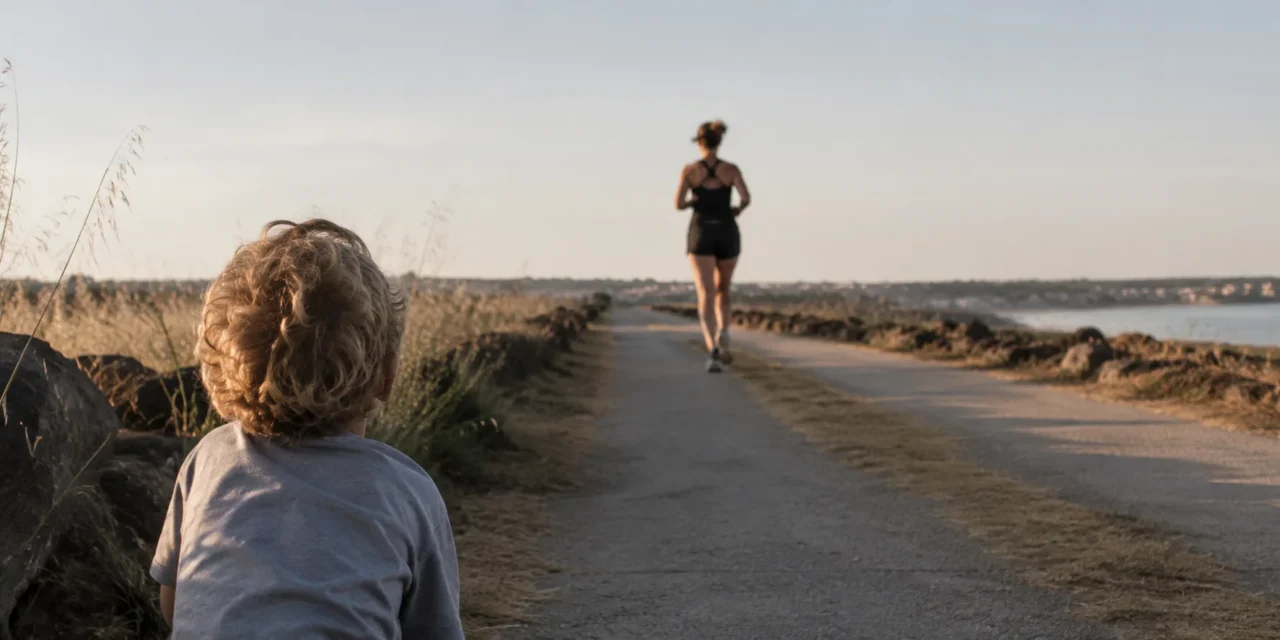
Most mothers have heard the same sentence more times than they can count.
“Is all that training really worth it?”
Sometimes it comes from family. Sometimes from friends. Sometimes from strangers on social media. And sometimes the loudest voice asking the question is your own. Because there will always be moments when you wonder whether you should skip your workout. Whether the long run is selfish. Whether preparing for HYROX, a marathon or simply becoming stronger takes something away from your children.
What if the opposite is true?
What if every early morning run, every strength session after work and every race medal hanging on the wall is quietly teaching your children lessons that no classroom ever could?
Not because you constantly tell them what they should do. Children are surprisingly resistant to lectures. But they are experts at watching. They notice everything. The alarm clock before sunrise. The muddy shoes by the front door. The vegetables on your plate. The smile after a difficult workout. The disappointment after a bad race. The decision to lace up your shoes anyway the next day. Long before they understand training plans, lactate thresholds or progressive overload, they are learning something much more valuable.
They are learning how adults deal with life.
They learn that discipline is stronger than motivation
Social media has created the illusion that successful people wake up every morning feeling unstoppable. Reality is much less glamorous.
Most athletes are not motivated every day.
Some mornings are cold. Some evenings are exhausting. Some workouts feel terrible before they even begin. Your children notice something remarkable during those moments. They see that you sometimes train even when you do not feel like it. That may sound insignificant to an adult, but for a child it is a revolutionary concept.
Children naturally believe that actions should follow emotions. If they feel like playing, they play. If they do not feel like tidying their room, they do not understand why they should. Then they watch you quietly put on your running shoes despite feeling tired. Without giving a motivational speech. Without dramatic music. Just because you said you would.
That is discipline.
And discipline is one of the greatest gifts a parent can demonstrate. Years later, when they are studying for exams they do not enjoy, preparing for job interviews or working towards their own dreams, they may not consciously remember your Tuesday morning strength session. But their brain has already learned that important things are often done before they become enjoyable.
They learn that hard things are not something to avoid
Modern life is incredibly comfortable. Food arrives with a tap on a phone. Entertainment is unlimited. Problems are solved instantly. Discomfort has become something many people try to eliminate as quickly as possible.
Training teaches the exact opposite.
You voluntarily choose something difficult. You lift weights that feel heavy. You run until your legs burn. You push through workouts that make you question your decisions. And afterwards? You smile. Your children witness something fascinating. Discomfort is not always dangerous. Sometimes discomfort is simply the entrance fee for growth.
This lesson reaches far beyond sports. Children who understand that temporary discomfort leads to long term rewards are often better equipped to deal with challenges in school, relationships, careers and life itself. They stop asking, “Is this difficult?” They start asking, “Is this worth it?”
They learn that failure is not the opposite of success
No athlete wins every race. No training cycle goes perfectly. Sometimes you get injured. Sometimes you miss a personal best by one second. Sometimes you finish far behind your expectations.
Children pay extraordinary attention to these moments.
Not because they care about finishing times. Because they want to see how adults react when life does not go according to plan. Do you throw everything away because one race was disappointing? Do you spend weeks talking about how terrible you are? Or do you allow yourself to be disappointed, recover emotionally and start planning the next challenge?
Resilience is rarely taught through words.
It is absorbed through observation. When your child watches you lose without giving up, they begin to understand that failure is simply part of becoming better. That mindset may become one of the greatest competitive advantages they ever develop.
They learn what a healthy relationship with food looks like
Children are surrounded by confusing messages about nutrition. One moment food is marketed as comfort. The next moment it becomes something people feel guilty about. Many grow up hearing adults constantly complain about calories, diets, body weight or foods they are supposedly not allowed to eat.
Sport can completely change that conversation.
Instead of asking, “Will this make me fat?” You start asking, “Will this help me recover?” Food becomes fuel. Protein supports stronger muscles. Carbohydrates provide energy for tomorrow’s long run. Healthy fats support overall wellbeing. Vegetables help your body function. Dessert is still enjoyed occasionally without guilt.
Your children notice that meals are no longer associated with shame.
Instead, they become connected with performance, energy and feeling good. That simple shift can shape a child’s relationship with food for decades.
They learn that bodies deserve respect instead of criticism
This lesson may be especially important for daughters. But sons need it just as much. Children hear how adults talk about themselves. Every negative comment leaves an impression.
“I hate my stomach.”
“I need to lose weight.”
“I look terrible.”
Imagine hearing something different.
“My legs carried me through fifteen kilometres today.”
“I feel stronger than last month.”
“I am proud of what my body can do.”
Training gradually shifts the focus from appearance to ability. Your body stops being a decoration. It becomes a tool. Something capable of incredible things. Children who grow up around this mindset often develop healthier body images because they learn to value function before appearance. Instead of asking whether their body looks perfect, they begin wondering what it is capable of achieving.
They learn confidence without arrogance
Real confidence is surprisingly quiet. It does not need to announce itself. It grows through repeated promises that you keep to yourself. Every completed workout is one more piece of evidence. You said you would train. You trained. You said you would finish. You finished. Eventually confidence stops depending on external praise because it has become internal proof.
Your children observe this transformation.
They notice that confidence is earned rather than purchased. Not through likes. Not through expensive clothes. Not through comparison. But through consistent effort over time. That lesson is incredibly rare in a world obsessed with instant validation.
They learn that mums are allowed to have dreams too
This may be the most emotional lesson of all. Many mothers unconsciously believe that becoming a parent means permanently placing themselves at the bottom of every priority list.
Their own ambitions become optional.
Their hobbies disappear. Their identity slowly shrinks until it revolves entirely around caring for everyone else. Children never ask for this sacrifice. In fact, they often benefit far more from seeing a fulfilled mother than an exhausted one. When they watch you work towards a race, celebrate a new deadlift personal best or proudly cross a finish line, they discover something beautiful. Mothers are people. They have passions. Goals. Dreams. Courage.
Children who grow up with mothers who continue growing themselves often develop a much healthier understanding of adulthood. Life does not stop after becoming a parent. It simply gains another reason to become stronger.
They learn consistency from ordinary days
The biggest lessons rarely happen on race day. Medals are exciting, but they are only brief moments at the end of a much longer process. Character is built on ordinary Tuesdays, during the easy recovery run, the strength session nobody applauds, the mobility work that never appears on Instagram, the Sunday evening meal prep and the early bedtime when everyone else is still awake. Children grow up surrounded by these quiet routines, and over time consistency becomes normal to them. Not something dramatic or exceptional, but simply the way responsible adults work towards goals that matter. That may be one of the greatest advantages we can give them.
You are building more than fitness
Every parent wonders what kind of legacy they will leave behind. Will we teach our children enough? Will we prepare them for the real world? Will they grow up to be kind, resilient and confident? There are no perfect answers, but every training session quietly contributes to that education. Not because fitness automatically makes someone a great parent, and certainly not because every mother needs to become a marathon runner or a HYROX athlete.
The distance you run, the weight you lift or the finish time on the results sheet will eventually be forgotten. What truly matters is that your children repeatedly witness an adult choosing growth over comfort, commitment over excuses, self respect over self criticism and courage over fear. They watch someone stumble, get back up and keep moving forward. Those are not sporting lessons. They are life lessons.
They are proud of you in ways you may never expect
Children rarely care about your finishing time or your ranking. They care about what your achievements mean to them.
One evening I sighed and said to my son, “Wow… I’ll already be 49 this year.” He looked at me for a second and simply replied, “And you just ran 47 kilometres.”
That was it. No discussion about getting older. No concern about age. In his eyes, growing older was completely overshadowed by what his mum was capable of doing. That moment reminded me that our children do not see our wrinkles before they see our strength. They see courage. They see determination. And perhaps most importantly, they feel incredibly proud of us, often far more proud than we ever realise.
The race they will always remember
One day your children will become adults. They will face their own impossible projects. Their own difficult conversations. Their own heartbreaks. Their own mountains that seem too high to climb. When that moment comes, they probably will not remember your finishing time at that local race years ago. They may not remember whether you placed first or last. They probably will not remember the colour of your running shoes or the brand of your training watch.
But somewhere deep inside, they will remember something much more important.
They grew up watching someone who believed that ordinary people can achieve extraordinary things through patience, consistency and courage. They watched someone choose progress over perfection. They watched someone become stronger one workout at a time. And without even realising it, they learned to believe the same about themselves.
Your children probably will not remember every race you finished.
But they will remember that their mum believed she could do hard things.
And one day, they will believe they can too.