
There is a saying in Germany: “Hochmut kommt vor dem Fall.”
The closest English equivalent is: “Pride comes before a fall.”
I have been thinking about that phrase a lot lately.
HYROX was founded in Germany, which naturally caught my attention early on. Not because I’m particularly patriotic, but because it’s always interesting to see an idea from your own country grow into a global movement. What impressed me wasn’t the nationality. It was the concept. HYROX managed to create something remarkably accessible: a competition that motivates complete beginners while still challenging experienced athletes. That’s not easy to achieve.
I wouldn’t describe myself as a HYROX fan girl. This was going to be my first race. I’m also relatively new to trail running, yet I was welcomed into that community with remarkable warmth from day one. By comparison, stepping into the HYROX world has often felt a little more intimidating, with its own culture, terminology and unwritten rules that can make it harder for newcomers to find their place. But I also admire what HYROX has built: professionally organised events, an exciting race format and an atmosphere that inspires people to push themselves beyond what they thought possible. That’s exactly why I wanted to experience it myself.
This journey began with three tickets. Three official HYROX Flex Tickets. One for Women Open Tenerife. One for Women Open Valencia. And one Youngstars ticket for my ten-year-old son. I deliberately paid extra for the Flex option. Tenerife was meant to be my first HYROX, with my son waiting for me at the finish line. Valencia was supposed to be different. There, we would both race. It felt like the beginning of something we could experience together. Then life happened. The person who was supposed to travel with us was suddenly no longer available, and with that, our plans fell apart.
I was faced with a question no parent wants to answer: what should my ten-year-old do while I’m on the course? For almost two hours, he would have been alone in a crowd of thousands of people. I simply wasn’t comfortable with that.
I looked for alternatives. I searched the HYROX website to see whether there was a supervised kids’ area, childcare or any kind of support for parents travelling with children. I couldn’t find anything, and the same situation applied to both events. Selling the tickets wasn’t about losing motivation or changing my mind about competing. It was about making a responsible decision as a parent.
So I did what I assumed any customer with official Flex Tickets would do. I put the tickets up for sale. To maximise my chances of finding a buyer, I listed them both in the large HYROX Facebook communities where thousands of athletes buy and sell race entries every week and on the HYBRID Tickets app, after completing the full verification process with my identity, my tickets and Stripe.
Like many athletes, I wasn’t entirely sure whether HYBRID Tickets was an official HYROX platform or an independent company working alongside HYROX. The branding, the verification process and the integration with HYROX registrations certainly made it feel like the official resale solution, so I followed every step. Then I waited.
Days passed without a single enquiry, message or offer. Since the tickets weren’t selling there, I continued advertising them in the large HYROX Facebook groups, assuming I would simply remove the listing from HYBRID if I found a buyer elsewhere. That seemed perfectly reasonable, especially because the platform itself had previously told me:
“If you sell it before we have sold it you must let us know so we can delist it, or you can delete it from the app.”
To me, that sentence was unambiguous. It implied that selling the ticket elsewhere was perfectly acceptable, as long as I informed the platform afterwards or removed the listing myself. One day later, however, I noticed that all three of my tickets had disappeared from the app. I hadn’t sold them, I hadn’t removed them, and I certainly hadn’t asked anyone to delist them. Shortly afterwards, I received another message:
“We have removed your tickets for sale as we see you have them listed on Facebook with PayPal payments.”
I read the email several times because I genuinely thought I had misunderstood something. But the more I compared both messages, the less sense they made together. The first suggested that selling elsewhere was expected, provided the listing was removed afterwards. The second implied that merely advertising the tickets elsewhere was enough to have them removed altogether. At no point had I been told that listings had to be exclusive. At no point had I been asked to choose between Facebook and HYBRID Tickets. I only discovered that rule after my tickets had already been removed.
That was the moment I realised this article wasn’t really about three tickets. It was about something much more fundamental: communication. And ultimately, trust.
Why This Worries Me Professionally
I should probably explain why this experience stayed with me longer than it might have stayed with someone else.
I’ve spent almost twenty years working in digital marketing, specialising in search, user experience and customer journeys. I love creating information architectures that work for both people and algorithms. But getting someone to a website is only half the job. The real challenge begins afterwards. Turning visitors into customers is one thing. Turning customers into loyal advocates is another. That only happens when the entire customer experience lives up to the promise that brought them there in the first place.
Long before I became part of this story myself, I had already noticed something about HYROX. Whenever questions came up in Facebook groups, I often found myself thinking, “This could have been communicated much more clearly.” Athletes were explaining the rules to one another, unofficial communities had become a source of support, and people were piecing together important information from Reddit instead of finding it through official channels. At the time, it wasn’t my problem. It was simply something I observed professionally.
This time, it became my problem.
Looking back, I don’t think the biggest issue was that my tickets were removed. Companies are free to define their own policies. What concerns me is something much more fundamental: communication. Customers can accept almost any rule if it is explained clearly and consistently. What they struggle with is uncertainty. Contradictory messages create friction, friction creates frustration, and frustration eventually erodes trust.
That is why I believe HYROX is standing on surprisingly thin ice. Not because the races aren’t exceptional, because they are, but because the stronger the emotional connection people have with a brand, the more every disappointing interaction matters. People rarely become frustrated because they don’t care. They become frustrated because they expected better.
Of course, one frustrating experience proves nothing. It would have been easy to dismiss my own case as bad luck. So I started looking beyond it. I read discussions on Reddit and Facebook, browsed Trustpilot reviews and compared experiences from athletes in different countries and at different events.
The individual stories varied, from ticket transfers and refunds to registration issues and customer support, but the underlying themes remained remarkably consistent:
- Customers struggle to understand which rules actually apply.
- Support often explains policies instead of helping solve problems.
- Communication feels inconsistent across different channels.
- Athletes frequently turn to Facebook or Reddit because they cannot find clear answers through official sources.
Interestingly, very few complaints are actually about refunds. Most athletes seem to understand that event organisers cannot simply refund every cancelled participation. The frustration comes later. It comes when people feel that nobody is genuinely trying to help.
A Community Shouldn’t Need Detectives
While researching this article, one word kept coming back: transparency. Or, more accurately, the lack of it. My own experience is a good example. I couldn’t tell whether HYBRID Tickets was officially operated by HYROX or an independent partner. I couldn’t tell whether listings had to be exclusive. And I couldn’t understand why my tickets had been removed when an earlier message had explicitly suggested that I could simply delete the listing myself if the tickets sold elsewhere.
None of these questions are particularly complicated, and that’s exactly the point. Good user experience isn’t about making every rule flexible. It’s about making every rule easy to understand.
The Irony of Fighting Scammers
HYROX clearly wants to protect athletes from fraud, and that’s a goal every athlete can support. But good intentions don’t automatically create good customer experiences. In some cases, they can have exactly the opposite effect.
I bought official Flex Tickets, verified my identity, verified all three tickets, connected Stripe and followed every step of the official resale process. Yet I was the one whose listings were removed. A scammer, on the other hand, can create another Facebook account tomorrow morning. Scammers don’t care about official processes. Honest athletes do.
That is why the current system feels counterproductive. The harder you make legitimate resale, the more attractive unofficial channels become. Risk doesn’t disappear. It simply moves from a verified platform to Facebook Messenger and WhatsApp. I can’t imagine that this is where HYROX wants its community to buy and sell tickets.
The Greatest Strength of HYROX Could Also Become Its Greatest Risk
One of the biggest reasons for HYROX’s success is its community. Unlike many sporting events, athletes don’t just compete once and move on. They come back, bring friends, convince colleagues, encourage training partners and inspire entire gyms to sign up. Coaches build programmes around HYROX, Instagram fills with race photos and YouTube creators analyse pacing strategies. Very few sports have managed to generate this level of organic enthusiasm.
That enthusiasm is incredibly valuable because it can’t be bought. HYROX wasn’t built by celebrity endorsements or expensive advertising campaigns. It was built by athletes telling other athletes, “You have to try this.”
But communities are built on trust, and trust is surprisingly fragile. People rarely fall out of love with a brand overnight. It usually happens through a series of small disappointments. A confusing process. A frustrating support interaction. A feeling that nobody is really listening. Over time, enthusiasm gives way to hesitation.
The real risk isn’t that people stop participating. The real risk is that they stop recommending HYROX to others. And for a brand that has grown primarily through word of mouth, that is a far greater threat than losing a single customer. Which is why I believe athletes should never be treated as registration numbers. They are HYROX’s greatest ambassadors, and ultimately its most valuable asset.
What HYROX Could Do Better
The encouraging part is this: None of these problems require reinventing HYROX. This article isn’t asking HYROX to change its sport. It’s asking HYROX to improve the experience surrounding it. Here are five changes that, in my opinion, would have an immediate impact.
1. Build an Official Resale Platform
If HYBRID Tickets is the official resale partner, make that unmistakably clear. If not, create a fully integrated HYROX marketplace where athletes can safely buy and sell verified tickets, complete with transparent fees, automatic athlete transfers and clear communication. No screenshots, no Facebook Messenger and no uncertainty about whether a transaction is legitimate.
2. Explain the Rules Before They Matter
Most customers have no problem accepting rules if those rules are communicated clearly. If listings must be exclusive, say so before someone publishes a ticket. If parallel listings are prohibited, explain why. Customers should never discover important restrictions only after they’ve unknowingly broken them.
3. Solve the Customer’s Problem
Good customer service isn’t about quoting policies. It’s about understanding why someone is asking for help and finding the best possible solution within those policies. Sometimes the answer will still be “no”, but customers should leave the conversation feeling that someone genuinely tried to help.
4. Keep Listening
One of HYROX’s greatest strengths is its community. Athletes constantly share ideas, feedback and suggestions because they care deeply about the sport. That should be seen as an opportunity, not a problem. The loudest critics are often the people who want the brand to succeed the most.
5. Protect the Trust You’ve Earned
Trust rarely disappears because of one major mistake. It fades through dozens of small disappointments: an unclear email, a confusing process or a frustrating support interaction. Individually they seem insignificant. Together they shape how people feel about a brand, and in the end, that’s what determines whether they come back and whether they recommend it to others.
Pride Comes Before a Fall
I chose that title very carefully. Not because I believe HYROX is arrogant. I don’t know the people behind the company, and this article isn’t about individuals. It’s about something I’ve observed repeatedly throughout my career. Success has a habit of creating blind spots. As companies grow, they naturally focus on scaling, expanding into new markets and delivering bigger events. In the process, it’s easy to overlook the small frustrations customers experience along the way.
Those frustrations rarely show up in revenue reports. They appear first in conversations, in Reddit threads, in Facebook groups and in reviews. Left unaddressed, they slowly become part of the brand itself.
I’ve seen this pattern more than once. The companies that thrive over the long term aren’t the ones that avoid mistakes altogether. They’re the ones that recognise them early, listen carefully and keep improving. HYROX has already built a world-class race. Now it has the opportunity to build a world-class customer experience.
Update
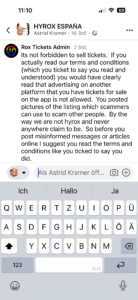
After publishing this article, I received an interesting clarification. HYBRID Tickets informed me that they are not affiliated with HYROX. I hadn’t realised that. Looking at the app’s branding and visual identity, I had assumed it was part of the official HYROX ecosystem.
HYROX should be aware that the visual similarities are likely to lead some athletes to the same conclusion.
That distinction actually reinforces one of the central points of this article. If an experienced user can misunderstand the relationship between different platforms, the customer journey is not as clear as it could be.
Whether responsibility lies with HYROX, HYBRID Tickets or both, the athlete experiences the process as one journey. And that journey should feel clear, transparent and supportive from start to finish.