
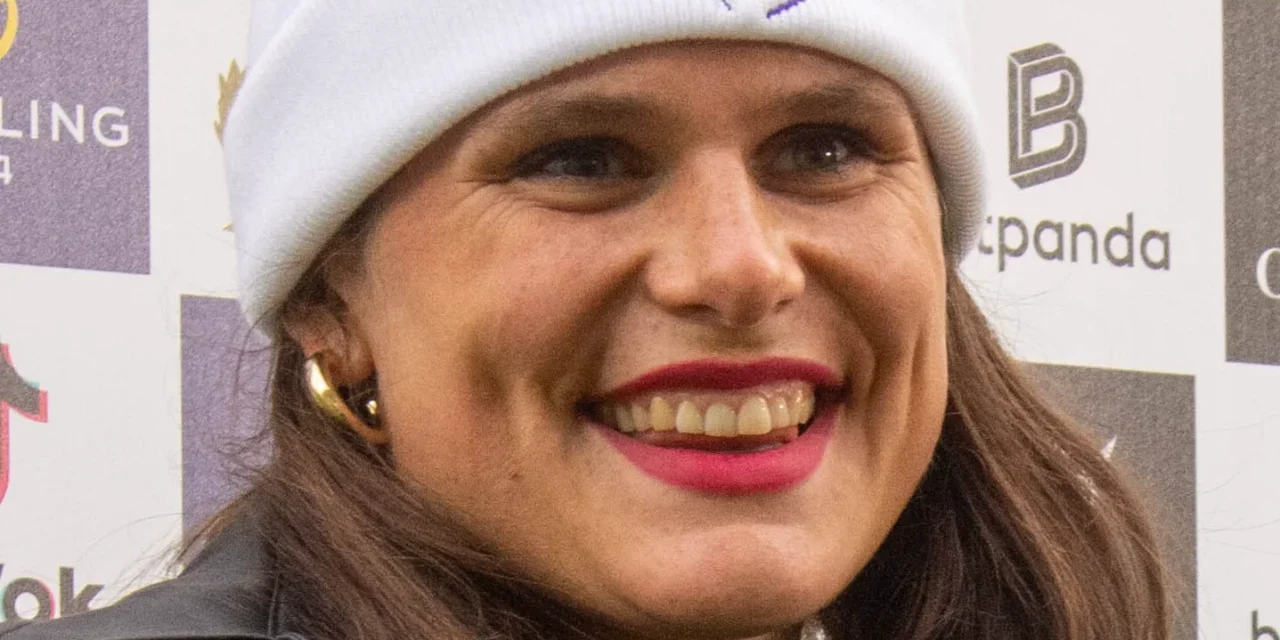
The Body They Kept Talking About
Give Ilona Maher the ball near halfway and the pattern is almost always the same. She turns upfield at full speed. One defender steps into her path, then another. The first tackle slows her for barely a second. She drives through it with the strength of her legs, shrugs off the second challenge and keeps moving as teammates race up beside her. Every metre has to be earned against players who are just as determined, just as highly trained and just as willing to throw themselves into the collision.
Yet Maher keeps going. On a rugby field, her body is not something to be explained. It is a weapon, carefully built through years of training and one of the reasons she became an Olympic medallist and one of the most recognisable rugby players in the world.
Hours later, the same body is being judged again. This time, not by defenders trying to stop her, but by strangers staring at a screen. They call her overweight. They ask whether she is really a woman. They wonder if she takes steroids. One comment points to her Body Mass Index as though a single number could somehow outweigh everything she had just done on the pitch.
Maher smiles into the camera, reads the comment aloud and answers it herself. Calmly. Confidently. Almost amused. She explains that yes, her BMI is higher than many people expect, and no, it has never stopped her becoming an Olympian or winning an Olympic medal. The problem, she says, isn’t her body. The problem is believing that a woman’s body can be understood by a number instead of by what it is capable of doing.
That moment has become typical of Ilona Maher. Whether she is charging through defenders on a rugby field or confronting millions of people online, she meets both with exactly the same attitude. She refuses to make herself smaller.
Learning What Her Body Could Do
Long before millions of people began discussing Ilona Maher’s body online, she had already learned how easily a number could change the way a girl saw herself. As a child, she was repeatedly told that her Body Mass Index placed her in the overweight category. Years later, she recalled feeling embarrassed when a school medical form labelled her overweight before she handed it in. The calculation said nothing about how fast she could run, how hard she could train or how naturally strength came to her. Yet for a young girl growing up in a culture that often equated thinness with discipline, health and femininity, that single word was difficult to forget.
Sport gradually offered her another way of understanding herself. Maher played field hockey, basketball and softball before discovering rugby at the age of seventeen, during her final year of high school. She continued playing at Norwich University before transferring to Quinnipiac, where the qualities that had once made her feel different became impossible to separate from her talent. Her size gave her power in contact, but power alone was not enough. She had the speed to exploit space, the balance to stay on her feet through tackles and the awareness to make decisions while defenders closed around her. Rugby did not ask her body to become smaller or more acceptable. It asked what it could contribute, and the answer was more than she had been taught to expect.
She progressed quickly, moving from collegiate rugby into the United States national programme and eventually onto the Olympic stage. By then, the body once reduced to a category on a chart had been shaped into the body of an elite athlete through years of sprinting, lifting, tackling, recovering and beginning again. Maher did not become successful in spite of her shoulders, her legs or her physical presence. She became successful through them, while also developing the skill and intelligence required to compete at the highest level of a sport that punishes hesitation and exposes every weakness.
That distinction would later become central to the way she spoke about body image. Maher was not interested in reassuring women that their bodies deserved acceptance only because every body could be called beautiful. She offered something more useful and more disruptive. A woman’s body could be valued for its strength, its endurance, its speed and the work it allowed her to perform, even when it did not resemble the narrow image she had been taught to pursue. Rugby had not merely given Maher a career. It had given her a different measure of herself, one that no comment section and no calculation could easily take away.
The Price of Being Powerful
Success did not silence the criticism. Male rugby players with the same muscular build were celebrated as physical specimens. Maher was expected to explain herself.
She refused.
Rather than ignoring the comments or answering them with anger, Maher did something far more effective. She invited millions of people into the conversation. Sitting in front of her phone, often with little more than a smile and a sense of humour, she read the comments aloud and dismantled them one by one. When critics pointed to her BMI as proof that something was wrong with her body, she calmly explained that the calculation had no understanding of muscle mass, elite performance or the demands of Olympic rugby. The number, she reminded her audience, had never tackled anyone. She had.
What made these moments so compelling was that Maher never appeared defensive. She was not asking for permission to exist, nor was she trying to convince the internet that she was beautiful after all. She had already settled that argument with herself. Her videos became lessons in confidence rather than self defence, exposing how absurd it was that one of the strongest athletes in the world could still be expected to justify why she looked the way she did.
In doing so, Maher shifted the conversation away from appearance and back towards performance. Every tackle she broke, every sprint she finished and every medal she won became a reminder that the standards women are judged by are often completely disconnected from what elite sport actually demands. Her body was not failing to meet the expectations placed upon women. It was exposing how small those expectations still were.
Playing by Her Own Rules
For decades, female athletes have faced an impossible choice. Be feminine, but not too feminine. Be strong, but not too strong. Be successful, but never appear too ambitious. Ilona Maher quietly rejected the entire premise. She never saw a reason why a woman who could flatten an opponent on a rugby field should suddenly have to hide her lipstick, stop wearing dresses or apologise for enjoying fashion once the final whistle had blown.
Her social media channels became an extension of that philosophy. One day she was celebrating a bruising victory with her teammates, the next she was joking about dating, walking a red carpet or sharing her skincare routine. To some observers, the combination seemed contradictory. Serious athletes, they argued, should focus on sport instead of building an online audience. Maher understood something they did not. Men’s professional sport had spent decades building stars through television, sponsorship and billion-dollar leagues. Women’s rugby had not. If the spotlight wasn’t waiting for her, she would build one herself.
What began as a way of sharing her personality soon became something much bigger. Millions of people who had never watched a rugby match suddenly knew the name Ilona Maher. They followed her because she was funny, authentic and refreshingly unwilling to fit into a single category. Along the way, many stayed to watch the rugby as well. In a sport that rarely receives mainstream attention, Maher achieved something administrators and marketing campaigns had struggled to accomplish for years. She made people care.
Critics occasionally suggested that her growing fame distracted from her sporting career. The reality was almost the opposite. Rugby alone could not provide the financial security enjoyed by athletes in many men’s sports, and Maher has spoken openly about the fact that her online presence became a necessity as much as an opportunity. She was not choosing between being an influencer and an athlete. She was doing what countless female athletes have always had to do: building the career that her sport could not yet provide.
In many ways, that may be Ilona Maher’s greatest achievement. She did not wait for women’s rugby to become commercially valuable before believing it deserved attention. She made herself impossible to ignore, then used that visibility to pull the sport along with her. She was no longer playing by rules that somebody else had written. She was writing new ones, and millions of people were watching.
The Historical Record
What happened?
- Ilona Maher was born on 12 August 1996 in Burlington, Vermont, USA.
- She began playing rugby at the age of seventeen during her final year of high school, continued at Norwich University and later transferred to Quinnipiac, where she became one of the country’s leading collegiate players.
- Maher made her international rugby sevens debut for the United States in 2018.
- She represented the United States at Tokyo 2020, held in 2021, and at Paris 2024.
- At Paris 2024, the United States won bronze, the country’s first ever Olympic medal in women’s rugby sevens.
- During the Games, Maher became one of the most followed athletes on social media, using humour and honesty to introduce millions of people to women’s rugby.
- She has repeatedly spoken out against body shaming, the misuse of Body Mass Index (BMI) and stereotypes about strong female athletes.
- Maher has explained that her social media career grew out of financial necessity. Rugby alone could not provide her with the financial security available to leading male professionals, so she built an audience that would allow her to support herself beyond the sport.
- In January 2025, she made her Bristol Bears debut in front of 9,240 spectators, then a record crowd for a standalone Premiership Women’s Rugby fixture.
Why This Story Matters
Ilona Maher represents a new generation of female athletes. She did not have to fight for the right to compete, but she continues to fight for something just as important: the right to be powerful without apologising for it. In a world that still judges women’s bodies more readily than their achievements, she has refused to become smaller, quieter or less visible. Instead, she has transformed criticism into conversation, visibility into opportunity and social media into a platform for changing how strength in women is perceived.
She didn’t change to fit the rules. She changed the rules instead.
Sources
- Instagram – Ilona Maher (Highly recommended. If you’ve finished this chapter, her Instagram account is the perfect place to see why millions of people have fallen in love with her authenticity, humour and unapologetic approach to sport.)
- Olympics.com – Ilona Maher
- People – Ilona Maher Responds to BMI and Weight Criticism
- Reuters – Ilona Maher Says Her Popularity Was Born Out of Financial Necessity
- The Guardian – Generation TikTok: How Sportswomen Set the Bar Higher Than the Men
- The Guardian – How Ilona Maher Became One of the Biggest Stars of the Games
- Associated Press – Ilona Maher Brings New Attention to Women’s Rugby
- CBS News – Ilona Maher on Breaking Stereotypes and Empowering Women
Pic Source: Stefano Delfrate