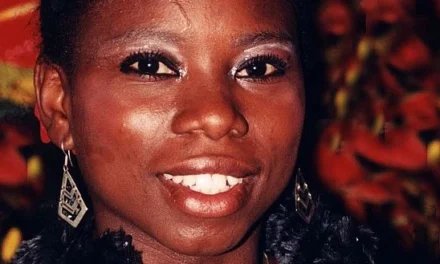

Do you remember Florence Griffith-Joyner?
Most people would say yes. They remember the long, brightly painted fingernails, the flowing hair, the lipstick and the racing suits that looked unlike anything else on the track. They remember the one-legged outfit she designed for herself. They remember the colours, the confidence and the name that seemed made for headlines: Flo-Jo. But ask a different question.
Do you remember what she actually achieved?
Florence Griffith-Joyner ran 100 metres in 10.49 seconds and 200 metres in 21.34 seconds. Both performances were recorded in 1988. Both became world records. Almost four decades later, both records still stand.
At the Olympic Games in Seoul, she won three gold medals and one silver. She won the 100 metres, the 200 metres and the 4 × 100 metres relay, then added silver in the 4 × 400 metres relay. In the 200 metres, she broke the world record in the semi-final and lowered it again only a few hours later in the final. She was not simply one of the most recognisable women in sport. She produced one of the most extraordinary sprinting seasons athletics had ever seen. Yet when Florence Griffith-Joyner is remembered, the image often arrives before the athlete. The fingernails come before the numbers.
Before the World Records
To many people, Florence Griffith-Joyner seemed to appear out of nowhere in 1988. In reality, she had spent years proving she belonged among the world’s best sprinters.
Born in Los Angeles on 21 December 1959, Florence Delorez Griffith grew up as one of eleven children in a working-class family. Her mother worked as a seamstress, and Florence developed an early fascination with fashion, colour and design. Long before the world knew her as “Flo-Jo”, she was sketching clothes, experimenting with hairstyles and refusing to believe that athletic excellence and femininity had to exist separately. She began running as a child and quickly emerged as one of America’s most promising young sprinters. After graduating from high school, she enrolled at California State University, Northridge, before continuing her athletic career at the University of California, Los Angeles (UCLA) under legendary coach Bob Kersee.
Her progress was not always straightforward. Financial pressures forced her to leave university for a time and take a job as a bank teller while continuing to train. Later, an athletic scholarship allowed her to return to UCLA, where she completed her degree in psychology while continuing to compete at the highest level.
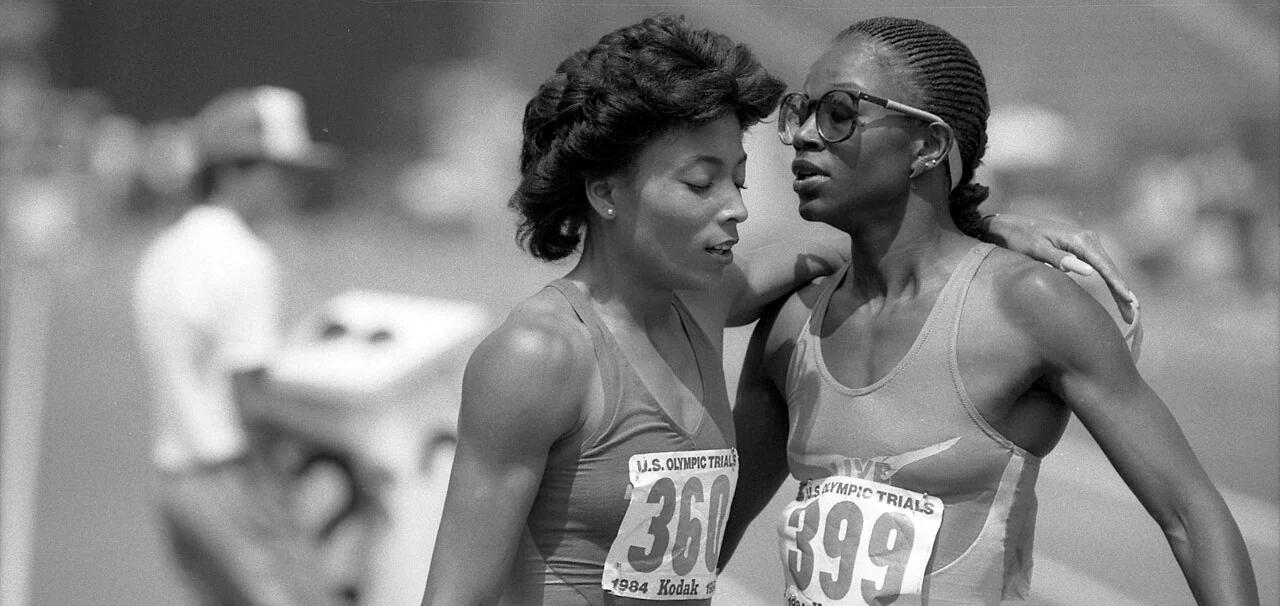
By the early 1980s, Griffith-Joyner was already among the world’s elite. At the 1983 World Championships she reached the final of the 200 metres. One year later, at her home Olympic Games in Los Angeles, she won the silver medal in the 200 metres. The race was won by her American teammate Valerie Brisco-Hooks, who completed one of the greatest Olympic performances in women’s sprint history by winning gold in the 200 metres, 400 metres and the 4 × 400 metres relay. Griffith-Joyner finished second, confirming that she already belonged among the world’s fastest women.
She continued to improve. At the 1987 World Championships in Rome, she claimed silver in the 200 metres and helped the United States win gold in the 4 × 100 metres relay. Nothing about Florence Griffith-Joyner suggested a one-season wonder. She had spent years climbing towards the top. What nobody could have predicted was what would happen in 1988.
The Season That Changed Everything
By the summer of 1988, Florence Griffith-Joyner was already one of the world’s best sprinters. She had won Olympic silver, stood on World Championship podiums and established herself among the elite. Yet even those who had followed her career closely could not have imagined what was about to happen.
The first sign came at the United States Olympic Trials in Indianapolis. On 16 July, Griffith-Joyner lined up for the quarter-final of the women’s 100 metres. The race lasted barely ten and a half seconds, but when she crossed the finish line, the stadium fell silent before erupting in disbelief. The clock showed 10.49 seconds. It was not just a personal best. It was 0.27 seconds faster than the existing world record, an extraordinary margin in an event where records are usually measured in hundredths of a second.
The performance immediately became one of the most discussed races in the history of athletics. Officially, the wind reading showed zero metres per second, making the time eligible as a world record. Yet observers quickly noticed that nearby events had been contested in strong tailwinds, leading some statisticians and scientists to question whether the wind gauge had malfunctioned. The debate has continued ever since. The record, however, has never been overturned and remains the official world record today. What is often forgotten is that Griffith-Joyner did not rely on a single extraordinary race. She won the Olympic Trials the following day in 10.61 seconds under legal conditions, confirming that her astonishing speed was no accident. Two months later, she arrived in Seoul as the woman everyone wanted to beat.
What followed remains one of the greatest Olympic performances ever produced by a sprinter. Griffith-Joyner won the 100 metres in commanding fashion before turning her attention to the 200 metres, the event in which she had already won Olympic silver four years earlier. In the semi-final, she broke the world record. A few hours later, she broke it again in the final, running 21.34 seconds, a mark that still stands today. By the end of the Games, she had collected three gold medals in the 100 metres, the 200 metres and the 4 × 100 metres relay, as well as a silver medal in the 4 × 400 metres relay. She had become the undisputed star of the athletics competition, combining breathtaking performances with a confidence and presence that captivated audiences around the world.
It should have been remembered simply as one of the greatest seasons in the history of athletics. Instead, almost as quickly as the medals were awarded, another conversation began to overshadow it.
The Conversation That Never Went Away
It began almost immediately. Florence Griffith-Joyner’s performances were so extraordinary that many people struggled to believe what they had seen. In the same Olympic year, Canadian sprinter Ben Johnson was stripped of his 100 metres gold medal after testing positive for anabolic steroids. Athletics was entering one of the darkest periods in its history, and suspicion spread far beyond those who had actually failed a drug test.
Griffith-Joyner had never tested positive for a banned substance. She underwent repeated drug tests during her career, including extensive testing before and during the Olympic Games in Seoul. Every official test came back negative. For some, that settled the question. For others, it never did.
Her dramatic improvement during the 1988 season, her increasingly muscular physique and the wider doping culture of the era fuelled speculation that has never completely disappeared. Over the years, journalists, former athletes and commentators repeatedly questioned whether such performances could have been achieved without performance-enhancing drugs. No evidence proving those allegations has ever emerged. At the same time, the absence of a positive test has never convinced everyone. The debate became part of her legacy.
When Florence Griffith-Joyner retired only months after the Olympic Games, some interpreted the timing as suspicious because athletics was introducing more extensive out-of-competition drug testing. Others pointed to the enormous commercial opportunities that followed her Olympic success and the fact that, at twenty-nine years old, she had already achieved everything an athlete could dream of. Both interpretations continue to exist today.
Her death in 1998, at just thirty-eight years of age, reignited the rumours once again. The official autopsy concluded that she died after an epileptic seizure associated with a congenital vascular abnormality in her brain. No evidence linked her death to performance-enhancing drugs. Yet even then, the speculation proved more durable than the medical findings.
Perhaps that is what makes Florence Griffith-Joyner’s story so remarkable. One of the greatest sprint seasons in history became inseparable from a debate that has never been resolved, not because evidence continued to emerge, but because suspicion proved easier to preserve than certainty.
The Image Everyone Remembered
Florence Griffith-Joyner understood something long before social media existed. If the world was going to look at her, she wanted to decide what it would see. She designed many of her own racing suits, choosing bold colours and cuts that stood out on the track. Her most famous outfit, the asymmetrical one-legged suit she wore in Seoul, became one of the defining images of the Olympic Games. She paired it with brightly painted fingernails, carefully styled hair and makeup that many people considered unusual for an elite athlete. None of it was accidental. It was an expression of who she was.
At a time when female athletes were often expected to appear practical, modest and almost invisible outside their performances, Griffith-Joyner refused to choose between being fast and being feminine. She rejected the idea that sporting excellence required women to suppress their personality. She believed she could be the fastest woman in the world while looking exactly the way she wanted.
The public had rarely seen anything like it. Newspapers, magazines and television programmes devoted almost as much attention to her appearance as they did to her victories. Fashion magazines featured her alongside models. Sports pages discussed her racing suits, her fingernails and her hairstyle with a fascination usually reserved for celebrities rather than athletes.
In many ways, Florence Griffith-Joyner succeeded. She became one of the most recognisable athletes on the planet and brought women’s athletics into places where it had rarely appeared before. She showed that female athletes did not have to hide their femininity in order to be taken seriously.
Yet there was an irony in that success. The image she had created became so powerful that, for many people, it eventually overshadowed the reason they had noticed her in the first place. Ask someone today what they remember about Florence Griffith-Joyner, and the answer is often immediate. The fingernails. The one-legged racing suit. The long hair. The colours. Only afterwards come the numbers.
Ten point four nine.
Twenty-one point three four.
The fastest woman in history had become one of the most recognisable athletes in history. The question is whether she also remained one of the most accurately remembered.
The Historical Record
What happened in 1988?
- Florence Griffith-Joyner had already won Olympic silver over 200 metres in Los Angeles in 1984 and World Championship silver in Rome in 1987.
- On 16 July 1988, she ran 10.49 seconds in the 100 metres at the U.S. Olympic Trials in Indianapolis, officially setting a new world record.
- The wind reading for that race has remained controversial, but the performance has never been invalidated and is still recognised as the official world record.
- At the Seoul Olympic Games, she won gold in the 100 metres, 200 metres and 4 × 100 metres relay, as well as silver in the 4 × 400 metres relay.
- In the 200-metre semi-final, she broke the world record before lowering it again to 21.34 seconds in the final.
- Her 100-metre and 200-metre world records still stand today, making them among the longest-standing records in athletics.
- Her extraordinary performances immediately prompted speculation about performance-enhancing drugs, despite her never failing an official drug test.
- Florence Griffith-Joyner retired from athletics in 1989 at the age of 29.
- She died unexpectedly in 1998 at the age of 38 after an epileptic seizure associated with a congenital vascular abnormality. No evidence linked her death to performance-enhancing drugs.
Women in This Chapter
- Florence Griffith-Joyner: Three-time Olympic champion, world record holder over 100 and 200 metres, and one of the most recognisable athletes in sporting history.
- Valerie Brisco-Hooks: Triple Olympic champion in Los Angeles 1984, where she defeated Griffith-Joyner in the 200 metres and became the first woman to win Olympic gold in both the 200 and 400 metres.
- Evelyn Ashford: Olympic champion and former 100-metre world record holder whose mark Griffith-Joyner surpassed in 1988.
- Jackie Joyner-Kersee: Olympic champion in the heptathlon and long jump, Griffith-Joyner’s sister-in-law and one of the greatest all-round athletes in history.
- Wilma Rudolph: Three-time Olympic champion whose achievements inspired Griffith-Joyner as a young sprinter.
Why This Story Matters
Florence Griffith-Joyner changed what a female athlete could look like without changing what excellence looked like. She embraced glamour, colour and individuality while producing one of the greatest sprint seasons in history. Yet many people remember her appearance before they remember her achievements, and the rumours before they remember the records.
Perhaps we remember Flo-Jo. The question is whether we remember Florence Griffith-Joyner.
Sources
-
- World Athletics – Florence Griffith-Joyner Athlete Profile
- World Athletics – Current World Records
- Olympics.com – Florence Griffith-Joyner
- USA Track & Field – Florence Griffith Joyner
- Olympics.com – Los Angeles 1984 Women’s 200 Metres Results
- Olympics.com – Florence Griffith Joyner: Flo-Jo’s Bold Legacy
- Vogue – Go with the Flo: A 1989 Profile of Florence Griffith Joyner
- TIME – 1988 Woman of the Year: Florence Griffith Joyner
- The Guardian – Florence Griffith Joyner at Seoul 1988
- CBS News – Flo-Jo Passed All Drug Tests
- CBS News – Joyner Autopsy Reveals Seizure
- The Washington Post – Coroner: Seizure and Suffocation Killed Griffith Joyner
Pic Source: Anacleto Rapping, Los Angeles Times