
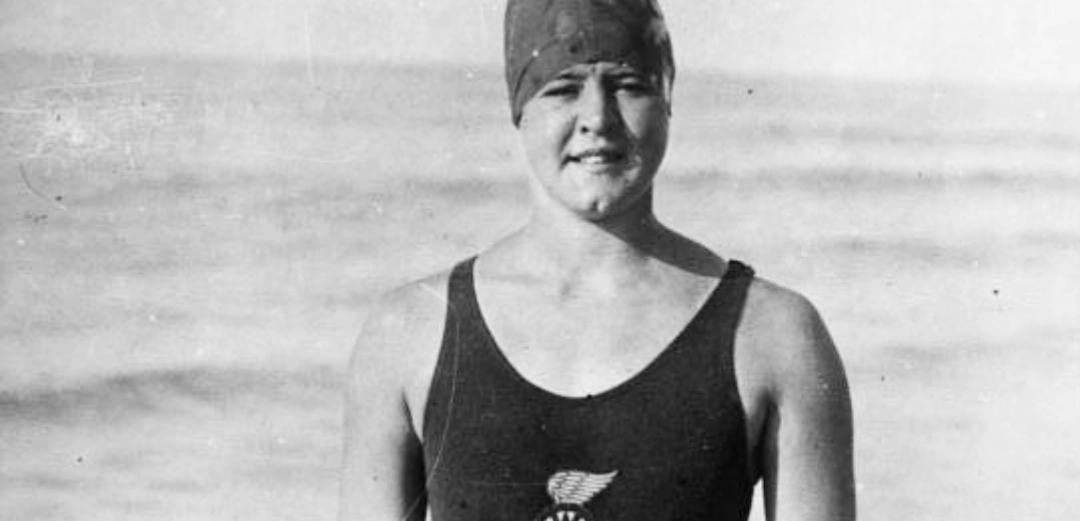
Gertrude Ederle’s older sister, Margaret, dipped her hands into a bucket of grease one last time. With practiced movements, she coated Gertrude’s shoulders, arms, back and legs in thick layers of lanolin and heavy grease, leaving only her face, hands and feet exposed. It was a familiar ritual before every serious Channel attempt. The grease could not keep the icy water out, but it slowed the loss of body heat, buying swimmers precious time in one of the coldest endurance challenges in the world.
Nearby lay a red swim cap, a pair of yellow goggles and a simple two-piece swimsuit. There would be no wetsuit, no GPS watch, no support from modern sports science. Once she entered the water, there would be only the tide, the current and nearly thirty-five kilometres of open sea.
At around 7:00 on the morning of 6 August 1926, Gertrude Ederle climbed into the water at Cap Gris-Nez on the French coast.
The English Channel was one of the greatest challenges in sport. Cold water, shifting tides and unpredictable weather meant that even the strongest swimmers could spend hours fighting only to be swept away from England at the very end. More people had climbed Mount Everest than successfully crossed the Channel would in the decades that followed. Between Matthew Webb’s first successful crossing in 1875 and the summer of 1926, only five people had ever completed the swim.
All five were men.
Gertrude Ederle was twenty years old. She was not there to become the first woman to swim the Channel. She was there because she believed she could be the fastest. On board the escort boat, her new coach Bill Burgess watched the sea carefully. He knew these waters better than almost anyone alive. Burgess himself had failed fifteen times before finally completing the crossing on his sixteenth attempt. He understood that success depended less on strength than on patience. A swimmer could not defeat the Channel. They had to work with it. Bill Burgess understood that. More importantly, he trusted Gertrude.
One year earlier, another coach had made a very different decision.
After almost nine hours in the water, Gertrude had still been swimming when Jabez Wolffe became convinced that she could not finish safely. He ordered Egyptian swimmer Ishak Helmy to enter the water and assist her. The moment Helmy touched her, the attempt was over. Gertrude protested immediately. She insisted she had never asked to stop. She believed she could have continued. Historians have debated Wolffe’s decision ever since. Some believe he genuinely feared for her safety after watching her struggle in the rough water. Others argue that he underestimated her endurance or simply refused to risk being responsible for the death of a young woman attempting a feat no woman had yet achieved. None of these explanations can be proven. The historical record cannot tell us why he made his decision. It can only tell us that Gertrude Ederle never forgave it.
Gertrude Ederle dismissed Jabez Wolffe. She hired Bill Burgess. On this August morning in 1926, she was back in the Channel. And this time, no one intended to take her out of the water.
Long before she stood on the French coast, Gertrude Ederle had already become one of the most accomplished swimmers in the world. Born in New York City in 1905 to German immigrant parents, she learned to swim as a child at the family’s summer cottage in Highlands, New Jersey. A bout of measles left her with permanent hearing loss, but it never kept her out of the water. By her late teens, she was collecting national titles at remarkable speed. Swimming for the Women’s Swimming Association under the guidance of Charlotte Epstein, one of the most influential advocates for women’s sport in America, Ederle helped redefine what female athletes were thought capable of achieving. She set numerous world records, won Olympic gold in the 4×100 metre freestyle relay at the 1924 Paris Games and added two bronze medals in the individual freestyle events. By the time she arrived in France in 1925, she was no outsider attempting an impossible dream. She was already one of the fastest swimmers on the planet.
Yet the English Channel was different. It was not a race against other athletes but against nature itself. Since Captain Matthew Webb became the first person to swim from England to France in 1875, the Channel had acquired an almost mythical reputation. Powerful tides could push swimmers kilometres off course. Water temperatures rarely climbed above 18 degrees Celsius, and a successful crossing often depended as much on timing and navigation as on endurance. Failure was expected. Success was exceptional.
After the disappointment of 1925, Ederle returned one year later with a new coach and a new strategy.
Bill Burgess respected the sea too much to underestimate it, but he also knew that persistence often mattered more than caution. Together they prepared meticulously for another attempt. Burgess studied the tides, planned every feeding stop and trusted Ederle’s aggressive front crawl, a stroke many experts still considered too exhausting for such a distance. Others advised her to slow down. Burgess never asked her to become a different swimmer. He believed her greatest strength was precisely the thing that made traditionalists uneasy: she was faster than anyone expected a woman to be.
For hour after hour, Ederle settled into the relentless rhythm of her front crawl. At regular intervals, the escort boat drew alongside, and food was lowered to her on the end of a pole so that no one would accidentally touch her. She drank hot broth and hot chocolate to replace lost energy and body heat. Sometimes there was fruit, sometimes pieces of chicken. Then she pushed the cup away and continued swimming.
The conditions changed constantly. Calm stretches gave way to choppy water. The current refused to carry her in a straight line, pulling her sideways and forcing Burgess to adjust the course again and again. The crew watched for signs of exhaustion. Burgess had seen too many attempts fail in the final hours to become optimistic too early. Every successful crossing required patience. Every unsuccessful one had looked promising until it suddenly wasn’t. Ederle gave them little reason to worry. Her stroke remained remarkably consistent. Instead of fading, she continued to move through the water with astonishing efficiency.
Late in the afternoon, the white cliffs of England grew larger. Crowds had gathered along the shore near Kingsdown, watching the small escort boat approach. Shortly after 9 p.m., after 14 hours and 31 minutes in the water, Gertrude Ederle reached the English coast and stepped onto the beach.
She had not only become the first woman to swim the English Channel. She had broken the men’s record by nearly two hours. For a brief moment in the summer of 1926, the fastest person ever to cross the English Channel was a twenty-year-old woman from New York.
The news travelled faster than Gertrude herself.
As newspapers around the world reported her arrival, the headlines struggled to capture what had just happened. She was celebrated as the first woman to swim the English Channel, but many papers went further. They recognised the achievement for what it was: the fastest Channel crossing ever recorded. The distinction mattered. Gertrude Ederle had not merely crossed a barrier for women. She had raised the standard for everyone.
When she returned to New York, an estimated two million people lined the streets for a ticker-tape parade along Broadway. It was one of the largest public celebrations the city had ever given an athlete. President Calvin Coolidge welcomed her to the White House. Songs were written in her honour. Children learned her name at school. For a brief moment, Gertrude Ederle was one of the most famous women in America.
And yet, fame can be surprisingly fragile. Ask who held the fastest English Channel crossing in 1926, and very few people will answer: Gertrude Ederle.
Part of the answer lies in the way her story came to be told. Over time, one description quietly replaced another. The woman who had set the fastest time became the first woman. It is a subtle change in language, but an important one. One phrase measures her against every athlete who had ever attempted the Channel. The other measures her only against half the population.
Both statements are true. Only one tells the full story. Gertrude Ederle did not become extraordinary because she was a woman who swam the English Channel.
She became extraordinary because, on 6 August 1926, nobody had ever swum it faster.
The Historical Record
What happened on 6 August 1926?
- Gertrude Ederle swam the English Channel from Cap Gris-Nez, France, to Kingsdown, England.
- She completed the crossing in 14 hours and 31 minutes.
- She became the first woman ever to swim the English Channel successfully.
- Her time was nearly two hours faster than the existing men’s record.
- The crossing was supervised by her coach, Bill Burgess, the second person ever to have swum the Channel.
- One year earlier, Ederle’s first attempt had been abandoned after her coach, Jabez Wolffe, ordered another swimmer to assist her, ending the swim under Channel rules.
- Upon returning to New York, she received a ticker-tape parade attended by an estimated two million people.
- For several years, Gertrude Ederle was among the most famous athletes in the United States.
People in This Chapter
- Gertrude Ederle: Olympic champion, world-record swimmer and the first woman to swim the English Channel, setting the fastest time ever recorded.
- Charlotte Epstein: Founder of the Women’s Swimming Association and one of the most influential promoters of women’s competitive swimming in the United States.
- Bill Burgess: Gertrude Ederle’s coach during her successful Channel crossing and the second person ever to swim the English Channel.
- Jabez Wolffe: Ederle’s first Channel coach, who ended her 1925 attempt after ordering another swimmer to assist her.
- Margaret Ederle: Gertrude’s older sister, training partner and closest supporter, who accompanied her to France and helped prepare her before both Channel attempts.
Why This Story Matters
Gertrude Ederle’s achievement did more than break a barrier. It redefined what was thought possible in endurance sport. She did not simply become the first woman to swim the English Channel. She became the fastest person ever to swim it.
For almost twenty-four years, Gertrude Ederle remained the fastest person ever to swim the English Channel. When Florence Chadwick finally broke her record in 1950, it was another woman who did so. Yet history gradually remembered one part of Gertrude Ederle’s achievement and quietly forgot the other. The record was eventually broken. The wording changed.
She wasn’t remembered as the fastest swimmer in the world. She was remembered as the first woman.
Sources
- International Swimming Hall of Fame – Celebrating the 100th Anniversary of Gertrude Ederle’s English Channel Crossing
- International Swimming Hall of Fame – Gertrude Ederle Biography
- International Olympic Committee – Gertrude Ederle
- TIME Magazine (1926) – Contemporary report on Gertrude Ederle’s Channel swim
- History – Gertrude Ederle becomes the first woman to swim the English Channel
- Gertrude Ederle – Historical overview and bibliography
- Bill Burgess – English Channel swimmer and coach
- Jabez Wolffe – English Channel swimmer and coach
- Charlotte Epstein – Women’s Swimming Association
- Margaret Ederle
Pic Source: Von Bundesarchiv, Bild 102-10212 / Unbekannt / CC-BY-SA 3.0, CC BY-SA 3.0 de, https://commons.wikimedia.org/w/index.php?curid=5414811