
Before Katie Taylor could become one of the greatest boxers in the world, she had to find a way to get into the ring.
In Ireland in the late 1990s, girls could train in boxing gyms. They could hit bags, learn combinations and spar. What they could not do was compete in officially sanctioned fights. Taylor had followed her older brothers into boxing and trained under her father, Pete Taylor, himself a former amateur boxer. When the boys from the gym travelled to competitions, however, Katie was supposed to stay behind. Sometimes, she didn’t.
She tucked her hair underneath her headguard so that nobody could see it and entered boys’ competitions under a name that revealed as little as possible: K Taylor. With the headguard on, she could pass unnoticed long enough to get into the ring. The problem came afterwards. Taylor later remembered the uproar when the fight was over, the headguard came off and officials realised that the boxer they had just watched was a girl.
It happened only occasionally, but the absurdity of the situation is difficult to miss. Katie Taylor was not trying to prove that she could beat boys. She was trying to get fights. The sport she wanted to compete in had no official place for her, so for a few rounds at a time, she removed the one piece of information that kept her out of it.
There was another problem with the future she imagined for herself. Taylor wanted to become an Olympic champion. According to her mother Bridget, that ambition appeared before anyone even knew which sport might take her there. As a child of six or seven, Katie would stand on a chair in the family kitchen in Bray, raise her arms and pretend she was receiving an Olympic medal. Years later, at fifteen, she was already speaking publicly about winning one. There was just one fairly significant obstacle: women’s boxing was not an Olympic sport.
The First Fight
On 31 October 2001, Taylor no longer needed to hide her first name. At fifteen, she faced Alanna Audley of Belfast at Dublin’s National Stadium in the first officially sanctioned women’s boxing match in Ireland. Her father had been among those pushing the Irish boxing authorities to allow girls to compete, while her mother Bridget, who became Ireland’s first female boxing judge, was part of a family already challenging the boundaries around the sport.
The fight attracted an extraordinary amount of attention for two teenage boxers. Taylor won, but when she later remembered the night, it was not the result she described as the hardest part. It was the media attention. She was shy, just fifteen years old, and suddenly the simple act of two girls boxing had become news.
That first sanctioned fight opened a door, but Taylor’s ambitions were already much larger than Irish boxing. She began collecting international titles at a remarkable rate. In 2005 she won her first European Championship. In 2006 she became world champion for the first time, beginning a run that would eventually give her five consecutive World Championship gold medals and six European titles. At the same time, boxing was not even the only sport in which she represented her country.
Two Irish Jerseys
Katie Taylor was also an international footballer. She represented the Republic of Ireland at under-17 and under-19 level before making her senior debut in 2006. Between 2006 and 2009, she won eleven senior caps and scored twice for Ireland. For several years, one of the best amateur boxers in the world was simultaneously playing international football.
This was not a childhood hobby she had failed to give up. Taylor was good enough to have a genuine choice. Football offered a clearer route than boxing did, including opportunities to pursue the sport in the United States. Boxing offered something much less certain. There was still no women’s competition at the Olympic Games, and the sport Taylor had imagined herself winning an Olympic medal in since childhood did not yet have an Olympic medal for her to win. She chose boxing.
But Taylor and the people pushing women’s boxing forward were no longer prepared simply to wait for the Olympic programme to change. If the International Olympic Committee needed convincing, they would have to show it what women’s boxing had become.
Chicago, 2007
In November 2007, the men’s World Boxing Championships were being held in Chicago. Women’s boxing was not part of the championship programme, but Taylor was invited to take part in a demonstration bout against Canadian boxer Katie Dunn. Dunn was an accomplished international fighter and significantly heavier than Taylor, a difference that would not have been accepted in a normal competitive bout. This was not a normal competitive bout.
The purpose was bigger than the result. Women’s boxing was trying to secure a place at the Olympic Games, and showcase bouts were being used to demonstrate its quality to the people who could help make that happen. Taylor later described appearances such as Chicago as a kind of sales pitch for the sport. She was not only being asked to win. She was being asked to show what women’s boxing could look like on the world’s biggest sporting stage.
Before the fight, that responsibility was made explicit. Eric Donovan, Taylor’s Irish teammate and sparring partner, was with her in Chicago. Years later, he remembered the moment in the dressing room before she walked out to face Katie Dunn. Taylor was told that this was not simply another fight. She was going out there to help get women’s boxing into the London Olympic Games.
It was an extraordinary amount to place on one boxer. Taylor was twenty-one years old. She had already become world champion, but now the quality of her performance was supposed to help make an argument for an entire sport. The men competing in Chicago did not have to prove that men’s boxing deserved to exist at the Olympics. Katie Taylor walked into the ring knowing that, in some small but very real way, women’s boxing was still being asked to prove exactly that.
Donovan remembers what followed as a masterclass. Taylor overwhelmed Dunn, building a 15:0 lead in the opening round and ending the contest under the scoring rules then in use. The demonstration had barely begun before it was over.
There is something almost absurd about the sequence. Taylor had spent her childhood disguising herself as K Taylor because girls were not supposed to compete. Now she was standing at a World Championships being used as evidence that women belonged on one of the biggest stages in sport. And Chicago was not an isolated exhibition. Taylor took part in other showcase bouts as women’s boxing built its case for Olympic inclusion. For years, Katie Taylor had been trying to reach the Olympic Games through a sport that did not officially exist there. In Chicago, the question began to reverse.
Could the Olympic Games continue to leave women’s boxing out?
The Medal That Did Not Exist
In August 2009, the International Olympic Committee finally voted to include women’s boxing at the London 2012 Olympic Games. For the first time, women would compete in three weight divisions: flyweight, lightweight and middleweight. Katie Taylor was 23 years old. The Olympic gold medal she had been talking about since childhood finally existed.
Three years later, she arrived in London as the reigning world champion, the face of Irish boxing and one of the favourites for gold. The pressure was enormous. Taylor had spent years talking openly about becoming Olympic champion, and now an entire country expected her to do it. She later recalled switching off her phone weeks before the competition and retreating into a bubble to cope with the attention.
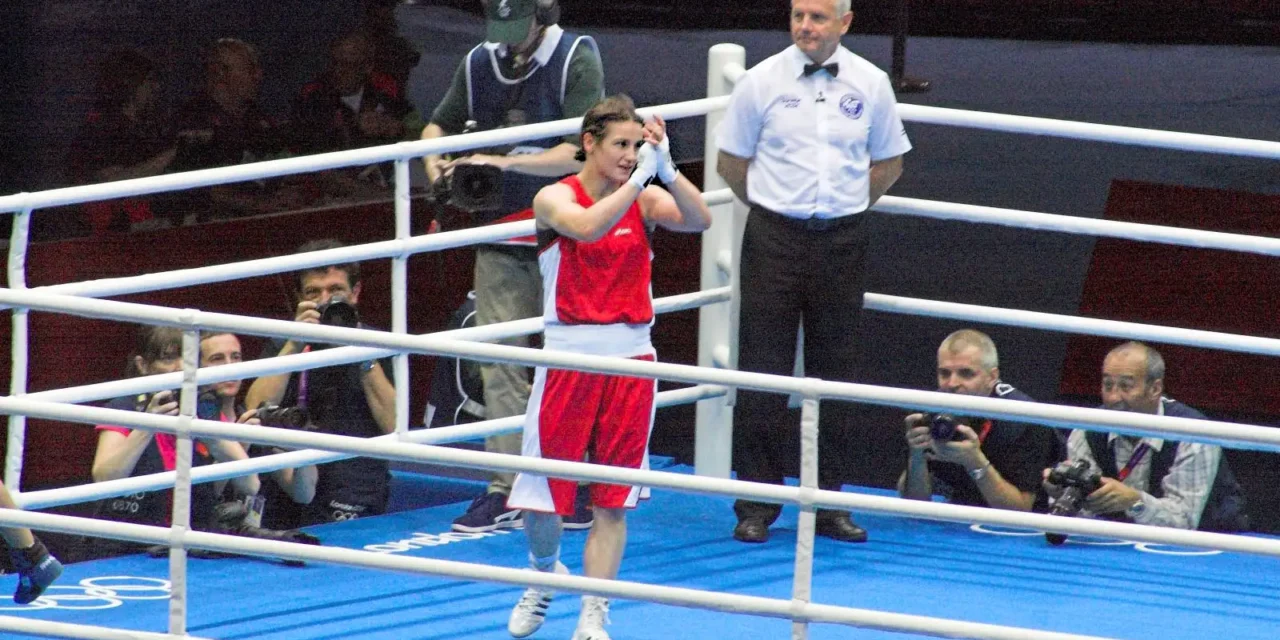
The atmosphere inside the ExCeL arena was anything but quiet. Irish supporters had travelled in huge numbers, and Taylor’s fights became some of the loudest events of the Games. In the lightweight final on 9 August 2012, she faced Russia’s Sofya Ochigava, an opponent who had beaten her before and knew her well. After four rounds, Taylor won 10:8.
She had spent years fighting for a place in a competition that did not exist. Now she stood on an Olympic podium while the Irish anthem played, with the first women’s lightweight boxing gold medal around her neck. It would be tempting to end the story there. Instead, that medal marks the end of the easiest part of Katie Taylor’s story to understand.
Without Her Right Arm
For more than a decade, Katie Taylor and her father Pete had been almost inseparable as boxer and coach. He had taught her the sport, built training around her when there was barely a structure for female boxers in Ireland and stood in her corner as she became European champion, world champion and Olympic champion. Their partnership was one of the foundations of her career. Then, in late 2015, it ended.
The reasons were personal. Pete and Katie’s mother Bridget had separated, and Katie made the decision to step away from her father as her coach. She has always resisted turning the details of the family breakdown into public material, but she has spoken openly about what the decision cost her. On her first day driving to training without him, she cried in the car. Going into the ring without her father in her corner, she later said, felt as though she were missing her right arm.
There is an important distinction in the way Taylor talks about that period. She did not describe leaving her father as a sporting decision that happened to have consequences. She knew it could damage her boxing and made the decision anyway. Her success in the ring, she said later, did not matter as much as her integrity.
The consequences came quickly. Taylor had been almost impossibly consistent throughout her amateur career, but in 2016 she began losing. She was beaten by Yana Alekseevna at an Olympic qualifier in April and by Estelle Mossely at the World Championships in May. She still qualified for Rio and arrived at the Olympic Games as defending champion and favourite, but the certainty that had surrounded her four years earlier was gone. In the quarter-final, Finland’s Mira Potkonen beat her by split decision. Taylor returned home without a medal.
For an athlete who had spent most of her adult life winning, the defeat was devastating. In the documentary Katie, she later walked into the room where her medals and trophies were kept and barely seemed interested in what was there. What occupied her was what was missing: the second Olympic gold medal she had expected to bring home from Rio. But Rio also forced a question that London had postponed. Katie Taylor had spent her amateur career helping to build women’s boxing into an Olympic sport. What was left for her to do in it?
The Message
Professional boxing was not the obvious answer. The women’s professional game Taylor was considering entering in 2016 looked nothing like the one she would later help create. Major promoters were sceptical. Women’s fights were rarely treated as significant attractions, purses were small and there was no obvious commercial path for even the most successful female amateur boxer in the world. Taylor had name recognition, particularly in Ireland, but Olympic fame did not automatically translate into a viable professional career.
After Rio, she travelled to Connecticut and began training with Ross Enamait. For the first time in years, she was building something outside the structure that had defined her amateur career. After a few weeks, she knew she wanted to turn professional. What she did next says almost as much about Katie Taylor as anything she has done inside a ring.
She contacted Eddie Hearn herself.
On 3 October 2016, Taylor sent the British promoter a direct message asking whether he would be interested in talking about her professional career. Hearn knew exactly who she was, but he has since admitted that he was sceptical about the commercial future of women’s boxing. His father Barry belonged to a generation of promoters who did not believe women should box at all, and similar attitudes remained widespread throughout the business.
Taylor did not approach Hearn simply asking him to find fights for her. When they met, she pitched something larger. She told him what she had already helped do for women’s amateur boxing and explained that she believed she could create the same kind of change in the professional sport. She wanted big events, television audiences and a career treated with the same seriousness as those of male champions. And she told him she needed a promoter capable of building it with her.
Hearn later admitted that when he walked into the meeting, he was not convinced women’s boxing had a big future. About ten minutes into the conversation, he wanted in. Less than two months after sending that message, Katie Taylor made her professional debut.
People laughed at Hearn for putting women’s boxing on major cards. When Taylor was given prominent billing at Wembley Arena, he remembered other people in boxing asking what he was doing. Women’s boxing, to much of the established professional game, was still a novelty, something to tolerate rather than something around which you built major events. Katie Taylor had encountered this problem before. As a girl, the sport had told her there was no place for her to compete, so she entered fights as K Taylor. As an amateur, the Olympic Games had told women there was no place for them, so she helped convince them to create one.
Now professional boxing was telling her that there might be a place for women, but nobody was particularly convinced that people would pay to watch them. Katie Taylor had heard some version of that argument for most of her life.
Would People Pay to Watch?
The answer came faster than almost anyone expected. Katie Taylor made her professional debut in November 2016. Less than a year later, she was world champion. By 2019, she held all four major lightweight belts and was the undisputed champion of the division. The boxer Eddie Hearn had initially been unsure how to promote was becoming one of the biggest names in his stable.
But winning titles was only part of what Taylor had promised him. She had told Hearn that she believed she could change professional women’s boxing in the same way she had helped change the amateur sport. That required something harder to measure than belts. Women’s fights had to become events people actively wanted to see. Female boxers had to move from the undercard to the top of the poster, and promoters had to believe that putting them there would sell tickets. For Katie Taylor, the clearest test of that idea eventually had a name: Amanda Serrano.
Taylor vs. Serrano
Serrano was already one of the most accomplished boxers of her generation, a Puerto Rican-born fighter from Brooklyn who had won world titles across seven weight divisions. A fight between her and Taylor had been discussed for years, delayed by negotiations and then by the pandemic. By the time it finally happened on 30 April 2022, there was no attempt to present it as an interesting women’s fight on somebody else’s card. Katie Taylor and Amanda Serrano would headline Madison Square Garden. No women’s boxing match had ever done that before.
The symbolism was difficult to miss. Madison Square Garden had hosted some of the defining nights in boxing history. Muhammad Ali and Joe Frazier had fought there. Roberto Durán had fought there. Joe Louis had fought there. For more than a century, the main event at the Garden had been one of the clearest signs that a boxer mattered commercially as well as competitively. Now two women were being asked to sell it. They did.
More than 19,000 people packed the arena. Irish flags filled one side of the crowd, Puerto Rican flags the other. The noise became so intense that Taylor later said she could not hear the bell. What followed was not a ceremonial milestone that needed to be celebrated because women had finally been allowed onto the stage. It was an extraordinary fight. Serrano hurt Taylor badly in the fifth round and appeared close to stopping her. Taylor survived, recovered and fought her way back into the contest. In the final seconds of the tenth, with the crowd roaring around them, both women stood in the centre of the ring and traded punches until the fight was over. Taylor won by split decision.
The question from 2016 had been answered. People would pay to watch women box. They would fill Madison Square Garden to watch them. They would produce one of the most talked-about fights of the year when they got there. And Taylor and Serrano were not finished.
Making the Main Event Normal
There is a danger in telling stories about firsts. A first can sound like the end of a problem: the door opens, the photograph is taken, history is made and everyone moves on. The more meaningful change comes when what once looked exceptional begins to look normal.
Taylor’s professional career increasingly moved in that direction. She continued to headline major events and defend her undisputed lightweight championship. In 2023, she moved up to super-lightweight to challenge Chantelle Cameron for another undisputed title. Cameron handed Taylor the first defeat of her professional career in Dublin. Six months later, Taylor fought her again, won the rematch and became an undisputed champion in a second weight division. Then came Serrano again.
Their second fight took place in November 2024 in front of an enormous global audience, with Taylor winning another close decision. Their third returned them to Madison Square Garden in July 2025, but this time the significance extended far beyond the two women in the main event. The entire professional card was female.
Madison Square Garden had never staged one before. Almost 20,000 people filled the arena while women competed for 17 world-title belts across the night. Alycia Baumgardner, Ellie Scotney, Shadasia Green, Savannah Marshall, Chantelle Cameron and other elite fighters were not being offered a token place on a men’s boxing show. They were the show.
Taylor defeated Serrano by majority decision, completing their trilogy with three victories. Afterwards, both women spoke about what they had created together. Their rivalry had become larger than either fighter’s record. Three years after becoming the first women to headline the Garden, they had returned at the top of a card on which every boxer was a woman. For Taylor, there was one place left.
Home
For years, Katie Taylor had talked about fighting at Croke Park in Dublin. It was the obvious final scale against which to measure what she had built. Croke Park is not a boxing arena. It is Ireland’s great sporting stadium, the home of Gaelic games, with space for more than 80,000 people. Filling it for a women’s boxing match would once have sounded absurd.
On 5 September 2026, Katie Taylor walked into Croke Park for the final fight of her career. She was forty years old. Her opponent was the unbeaten French boxer Flora Pili. Around 83,000 people were in the stadium.
Taylor won by unanimous decision and retired as the undisputed super-lightweight champion, ending her professional career with 26 victories and one defeat. When it was over, she placed her gloves in the centre of the ring. The numbers tell one version of what happened between her professional debut and that final night: world titles, two undisputed divisions, three victories over Amanda Serrano and a 26–1 professional record. But there is another way to measure the distance Katie Taylor travelled.
As a child, she hid her hair beneath a headguard and entered fights as K Taylor because knowing that she was a girl could keep her out of the ring. In Chicago, she was asked to demonstrate that women’s boxing was good enough for the Olympic Games. In 2016, she had to approach a promoter herself and convince him that professional women’s boxing could become something people wanted to watch. Then she filled Madison Square Garden. And finally, she came home to 83,000 people in Croke Park.
There was no need to hide the first name anymore. Katie Taylor was the name they had come to see.
The Historical Record
- As a young boxer, Taylor sometimes entered competitions as “K Taylor”, hiding her hair beneath her headguard because girls were not officially allowed to compete.
- On 31 October 2001, at the age of fifteen, she fought Alanna Audley in the first officially sanctioned women’s boxing match in Ireland.
- During her amateur career, Taylor won five consecutive World Championship titles and six European Championship titles.
- She also represented the Republic of Ireland senior football team between 2006 and 2009, earning 11 international caps and scoring two goals.
- In November 2007, Taylor fought Canadian boxer Katie Dunn in an exhibition bout at the Men’s World Championships in Chicago. The bout was explicitly used to promote women’s boxing as a future Olympic sport.
- Women’s boxing was added to the Olympic programme for London 2012.
- Taylor won gold in the lightweight division at London 2012, becoming the first Olympic women’s lightweight boxing champion.
- At Rio 2016, she was eliminated in the quarter-finals by Mira Potkonen.
- Later in 2016, Taylor turned professional after approaching promoter Eddie Hearn herself.
- She went on to become undisputed world champion at lightweight and later at super-lightweight.
- On 30 April 2022, Taylor and Amanda Serrano became the first women to headline a boxing event at Madison Square Garden.
- In 2023, Chantelle Cameron handed Taylor the only defeat of her professional career. Taylor won their rematch six months later.
- In July 2025, Taylor defeated Serrano for a third time at Madison Square Garden.
- On 5 September 2026, Taylor fought the final bout of her career against Flora Pili in front of approximately 83,000 people at Croke Park in Dublin.
- She won by unanimous decision and retired as undisputed super-lightweight champion with a professional record of 26 wins and one defeat.
Women in This Chapter
- Katie Taylor: Irish Olympic champion, two-weight undisputed professional champion and former Republic of Ireland football international.
- Alanna Audley: Belfast boxer who faced fifteen-year-old Katie Taylor in Ireland’s first officially sanctioned women’s boxing match in 2001.
- Katie Dunn: Canadian boxer who faced Taylor in the 2007 Chicago exhibition bout used to promote women’s boxing as a future Olympic sport.
- Sofya Ochigava: Russian boxer who faced Taylor in the lightweight final at the London 2012 Olympic Games.
- Mira Potkonen: Finnish boxer who defeated defending Olympic champion Taylor in the quarter-finals at Rio 2016.
- Amanda Serrano: Puerto Rican seven-division world champion whose trilogy with Taylor became one of the defining rivalries in women’s professional boxing.
- Chantelle Cameron: British boxer who handed Taylor the only professional defeat of her career in 2023. Taylor won their rematch six months later.
- Flora Pili: French boxer who faced Taylor in the final fight of her career at Croke Park in September 2026.
Why This Story Matters
Katie Taylor spent her career repeatedly entering spaces that were not built for her. As a girl, she hid her first name to get fights. As a world champion, she helped demonstrate why women’s boxing belonged at the Olympic Games. As a professional, she had to convince a promoter that women’s boxing could become a serious commercial sport. Each time, the argument was eventually settled in the ring.
She began as K Taylor because being a girl could keep her out of the ring. She ended as Katie Taylor in front of 83,000 people who had come to watch her fight.
Sources
- Team Ireland – Katie Taylor
- RTÉ Archives – Katie Taylor
- Sport Ireland – Katie Taylor wins exhibition bout at Men’s World Championships
- RTÉ – Memories of Katie Taylor and the Chicago 2007 Olympic showcase
- Olympedia – Katie Taylor
- Olympedia – Women’s Lightweight Boxing, London 2012
- Reuters – Katie Taylor defeats Flora Pili and retires at Croke Park
Pic Source: cormac70 from London via Flickr.