
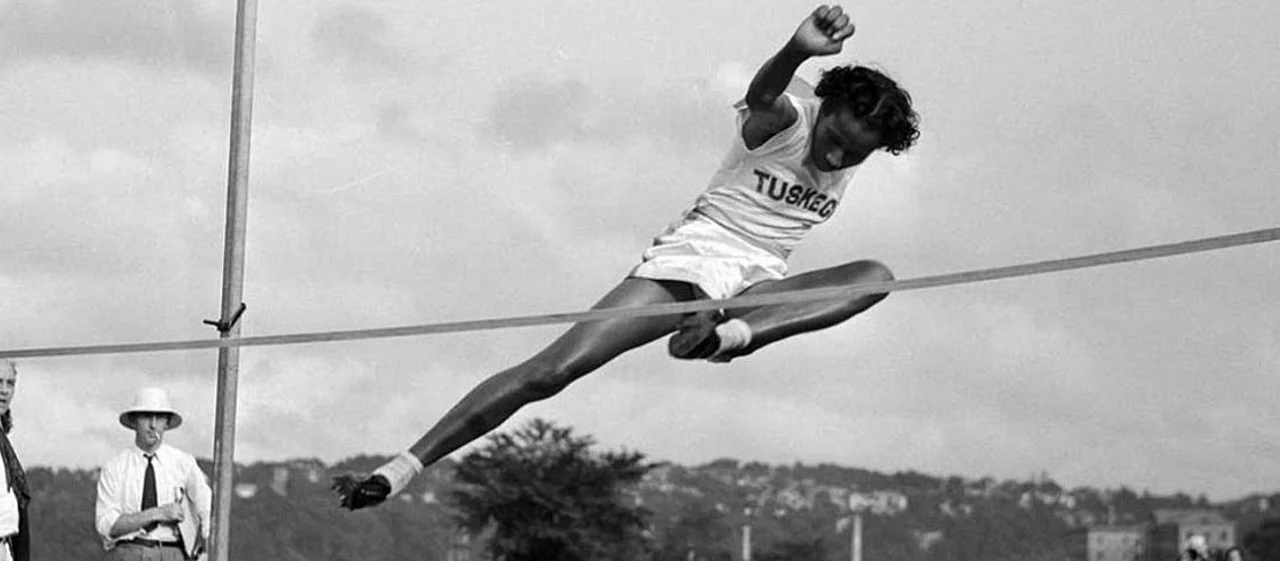
Brass bands echoed through the streets of Albany, Georgia, as thousands of people gathered to welcome home their Olympic champion. Children waved handmade banners. Families lined the pavements hours before the parade arrived. Somewhere beneath the late summer sun, a young woman sat high above the crowd, smiling and waving as the procession moved slowly through the city where she had grown up.
Just weeks earlier, Alice Coachman had stood on the highest step of the Olympic podium in London. On 7 August 1948, she had cleared 1.68 metres to win the women’s high jump, becoming the first Black woman in history to win an Olympic gold medal. Newspapers across the United States celebrated her victory. For a country still emerging from the Second World War, she was everything people wanted an Olympian to be: disciplined, gracious and extraordinary.
It seemed, for a few hours at least, as though sport had achieved something politics had not. Albany wasn’t simply celebrating an athlete. It was celebrating one of its own.
The parade wound through familiar streets before finally reaching the city auditorium, where the official ceremony would take place. Crowds pressed towards the entrance, eager to see the hometown girl who had conquered the world.
Alice Coachman did not walk through the front door.
According to contemporary accounts, she was directed instead to a side entrance reserved for Black guests. Inside, the audience remained divided by race. White spectators sat on one side of the hall, Black spectators on the other. When the mayor presented Coachman with a ceremonial key to the city, he did not shake her hand.
Outside, Albany celebrated an Olympic champion. Inside, the rules of segregation still applied. It is tempting to believe that greatness changes everything. That excellence speaks loudly enough to silence prejudice. Alice Coachman’s homecoming tells a different story. There was no woman anywhere in the world who could jump higher than Alice Coachman that summer.
Yet in her own hometown, she still could not enter through the same door as everyone else.
No Place to Train
Long before there were stadiums, officials or crowds waiting to applaud her, there was a dirt road outside Albany. Alice Coachman ran it barefoot. There was no track reserved for her, no proper equipment and no public sports programme waiting to discover what she could do. In the segregated American South, facilities existed. They simply were not built for Black girls like Alice.
So she made use of what was available. She sprinted along dusty roads and across open fields. She practised jumping over ropes, sticks and whatever else could be turned into an obstacle. She strengthened her legs by running, climbing and moving through the landscape around her. Before anyone taught her technique, she taught herself how to leave the ground.
Her family did not immediately see athletics as a future. For a girl born in Albany in 1923, sport was hardly an obvious path. Opportunities for women were limited. Opportunities for Black women were narrower still. But Alice kept running. She kept jumping. And eventually, the height she could reach became impossible for others not to notice.
Teachers at school recognised her speed and the ease with which she cleared obstacles. Their encouragement helped carry her beyond the dirt roads of Albany and towards the Tuskegee Institute in Alabama, one of the few places in the United States where a talented Black athlete could receive structured training as well as an education.
At Tuskegee, improvisation gave way to instruction. Coaches could measure her approach, correct her movement and place a real bar in front of her. What they could not teach was the instinct she had already developed: the timing, balance and explosive lift shaped through years of running barefoot and jumping over whatever the world had placed in her path.
By the early 1940s, Alice Coachman was dominating American track and field. She won national titles in the high jump year after year and competed successfully in sprinting events as well. She was not merely good enough to reach the Olympic Games. She appeared capable of winning them.
But there were no Olympic Games to enter.
The competitions scheduled for 1940 and 1944 were cancelled because of the Second World War. While the world waited, Coachman continued to win. One national title became another, and then another, until nearly a decade of her career had passed without the event that should have tested her against the best athletes beyond the United States.
For many competitors, the war interrupted an Olympic dream. For Alice Coachman, it consumed the years in which she might have been at her absolute peak. By the time the Games finally returned in 1948, she had already spent years proving herself without the one stage large enough to make the world watch.
The Jump That Changed History
By the summer of 1948, Alice Coachman had already waited longer than many Olympic careers ever lasted. When the Games scheduled for 1940 were cancelled because of the Second World War, she was only seventeen years old and already one of America’s most promising athletes. Four years later, another Olympic Games disappeared. While the rest of the world fought a war, Coachman continued to win. National title followed national title, yet there was no Olympic stadium waiting at the end of the season. There was only another year of proving herself without ever having the chance to prove it to the world. By the time the Games finally returned to London in 1948, she was twenty-four years old. For almost a decade, many believed she was the finest high jumper alive. Now, at last, she had the opportunity to find out.
The women’s high jump took place on 7 August at Wembley Stadium. Coachman arrived carrying a back injury that had troubled her in the weeks before the Games, but after waiting eight years, withdrawing was never an option. As the bar rose, the field grew smaller. Athlete after athlete failed to clear the next height until only two remained: Alice Coachman of the United States and Britain’s Dorothy Tyler, competing before a home crowd. The winning height was 1.68 metres. Coachman began her approach, accelerated towards the bar and cleared it cleanly on her first attempt. Tyler could not. She tried again. Then once more. Under the rules of the time, every failed attempt counted. Tyler’s third miss ended the competition.
Alice Coachman was Olympic champion.
With one jump, she became the first Black woman in history to win an Olympic gold medal. Newspapers around the world celebrated a sporting milestone, but Coachman herself rarely spoke about breaking barriers. Instead, she remembered something much simpler: after nearly a decade of waiting through cancelled Olympic Games, she had finally been given the opportunity every great athlete hopes for — the chance to compete on the biggest stage in the world.
Gold Wasn’t Enough
For a few weeks, Alice Coachman was one of the most celebrated athletes in America. Newspapers printed her photograph. Children looked up to her. She returned home carrying an Olympic gold medal, a ceremonial key to the city and the admiration of millions. In time, she became one of the first Black female athletes to sign major commercial endorsement deals, including a partnership with Coca-Cola. She devoted much of her later life to coaching, education and creating opportunities for young people, determined to make the path easier for those who would follow.
Yet the image that lingers is not the medal ceremony in London. It is the door in Albany.
History remembers Alice Coachman as the first Black woman to win Olympic gold. It remembers the record books, the photographs and the podium. Less often does it remember what happened when she came home. The side entrance. The segregated audience. The mayor who honoured her with a key to the city but would not shake her hand. Sport had made her the best high jumper in the world. It had not made her equal.
Stories like Alice Coachman’s are often told as proof that talent eventually overcomes prejudice. There is truth in that. But there is another truth as well. Talent may open the stadium gates. It does not always open the front door. On the Olympic podium in London, Alice Coachman cleared the highest bar in the world.
Back home in Georgia, the lowest barrier remained.
The Historical Record
- Alice Coachman won the women’s high jump at the 1948 Olympic Games in London with a clearance of 1.68 metres.
- She became the first Black woman in history to win an Olympic gold medal.
- Coachman had already won ten consecutive U.S. national high jump titles before her Olympic victory.
- The Olympic Games of 1940 and 1944 were cancelled because of the Second World War, delaying her opportunity to compete for Olympic gold.
- When she returned to Albany, Georgia, she was honoured with a parade and a civic reception. Contemporary accounts report that, because of racial segregation, she entered the auditorium through a side entrance, the audience remained segregated, and the mayor did not shake her hand.
People in This Chapter
- Alice Coachman – Olympic high jump champion and the first Black woman to win Olympic gold.
- Dorothy Tyler – British high jumper and silver medallist at the 1948 Olympic Games.
- Evelyn Boyd – Coach at Tuskegee Institute who helped develop Coachman’s talent.
Why This Story Matters
Alice Coachman’s story is often remembered as a breakthrough. It was. But it was also a reminder that sporting success does not automatically erase social barriers.
She reached the highest podium in world sport, yet discrimination still followed her home. Her achievement changed Olympic history. It did not immediately change the society she returned to.
Because winning a gold medal doesn’t always mean winning equality.
Sources
Primary & Contemporary Sources
- International Olympic Committee (IOC) – Alice Marie Coachman athlete profile
- Official Report of the Organising Committee for the XIV Olympiad (London 1948)
- The New York Times – Alice Coachman, First Black Woman to Win Olympic Gold, Dies
Historical Research
- National Women’s History Museum – Alice Coachman
- New Georgia Encyclopedia – Alice Coachman
- Encyclopaedia Britannica – Alice Coachman
- World Athletics – Alice Coachman
Pic Source: Von berria.eus – berria.eus, https://www.berria.eus/paperekoa/1922/025/001/2021-07-25/1948-urtea.htm, CC BY-SA 4.0, https://commons.wikimedia.org/w/index.php?curid=107887436