
The morning of 19 April 1967 began like dozens of Boston Marathons before it.
In Hopkinton, runners pulled sweatshirts over their racing gear to keep out the spring chill. Some bounced lightly on the spot. Others stood quietly with folded arms, saving every ounce of energy for the 26.2 miles ahead. Nervous laughter drifted through the crowd as friends wished each other luck. Officials moved along the starting area checking numbers, answering questions and urging runners toward the line. Nothing about the morning suggested that history was waiting a few miles down the road.
When the starter’s gun cracked through the air, the field lurched forward almost reluctantly. Thousands of feet settled into a steady rhythm as the runners left Hopkinton behind. Spectators clapped from the roadside. Children leaned over barriers hoping for a wave. Photographers searched for familiar faces among the pack. The race quickly found its rhythm, just as it always did.
Then someone noticed a woman.
For a brief moment, confusion spread faster than the runners themselves. A few spectators smiled. Others pointed. Some laughed in surprise. Most had never imagined they would see a woman wearing an official Boston Marathon race number.
One man did not laugh.
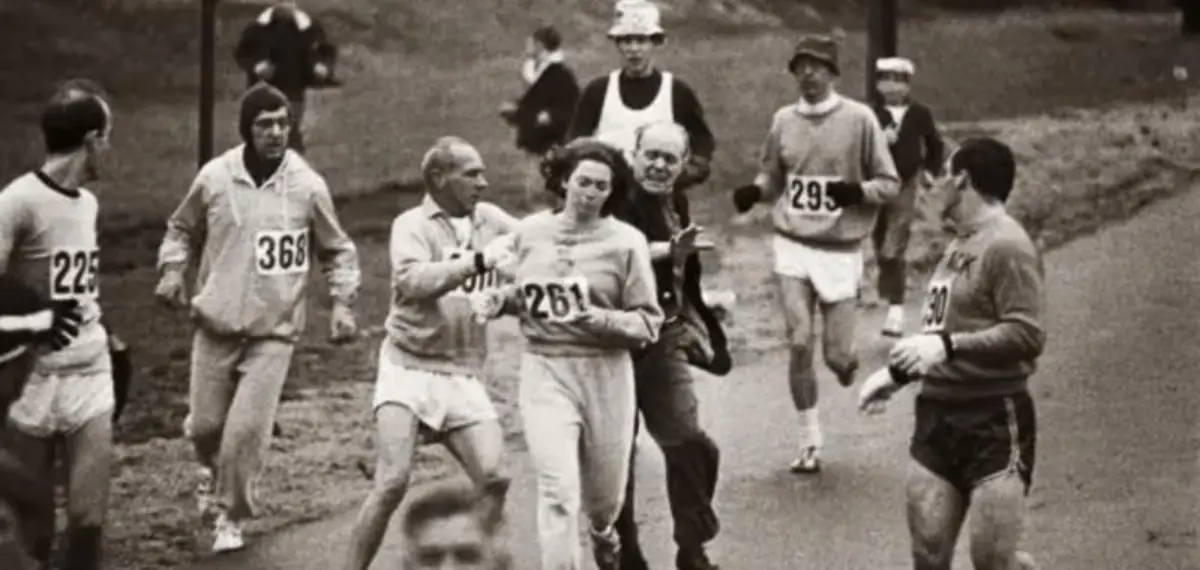
Jock Semple, one of the race officials and a lifelong guardian of the Boston Marathon, believed he was watching the rules of his race being broken before his eyes. Furious, he jumped from the press vehicle following the runners and charged onto the course. Within seconds, cameras turned away from the leaders. Photographers instinctively followed the movement as Semple forced his way through the pack, reached one runner and lunged for the race number pinned to the front of the grey sweatshirt. The photographs captured only an instant.
But that instant would become one of the most recognisable images in the history of sport. The runner wearing bib number 261 was a 20-year-old journalism student. Her name was Kathrine Switzer.
A Number They Didn’t Expect
It had never been Kathrine Switzer’s ambition to make history. She wanted to run a marathon.
At Syracuse University, where she studied journalism, running had become part of everyday life. She trained with the men’s cross-country team under Arnie Briggs, a veteran marathon runner who had completed Boston more than a dozen times. Briggs adored the race. He could recall mile markers, hills and weather conditions from years earlier as though they had happened yesterday. To him, the Boston Marathon was almost sacred. When Switzer told him she wanted to run it herself, he laughed. Not because he doubted her determination. He doubted the distance.
Like many runners of his generation, Briggs believed women simply were not built to run 26.2 miles. If they tried, he warned, they would collapse long before the finish. Switzer disagreed. She had already completed training runs that lasted well beyond twenty miles without difficulty. Finally, Briggs made her a promise.
“If you can prove to me in training that you can run the distance,” he told her, “I’ll be the first to take you to Boston.”
She did.
After one long winter training run of more than twenty-six miles, Briggs quietly admitted he had been wrong. True to his word, he helped her prepare for the race he loved more than any other. Entering Boston turned out to be remarkably uncomplicated. Switzer filled out the official application, enclosed the entry fee and signed the form exactly as she always signed her name: K. V. Switzer. She wasn’t trying to disguise who she was. Those were simply the initials she used in newspaper articles, university papers and everyday correspondence. A few weeks later, an envelope arrived. Inside was an official race number. 261.
One year earlier, another woman had already shown what was possible. Bobbi Gibb had hidden near the start, joined the race after the gun and completed the entire Boston Marathon without an official entry. She crossed the finish line ahead of hundreds of registered runners, proving that women could do exactly what they had been told they could not.
But nothing changed.
The assumptions remained. The rules remained. The marathon remained, in almost everyone’s mind, a race for men. On the morning of 19 April 1967, Kathrine Switzer pinned number 261 to the front of her sweatshirt. To everyone around her, it was just another bib. No one realised it was about to become one of the most famous numbers in sporting history.
The Moment the Cameras Couldn’t Ignore
For the first few miles, everything felt almost surprisingly ordinary. Switzer ran alongside Arnie Briggs, her boyfriend Tom Miller and a small group of runners who chatted easily as the miles passed beneath their feet. The cool air was perfect for running, spectators applauded from the roadside and no one seemed particularly interested in bib number 261. For a moment, it looked as though the race would simply continue.
Then Jock Semple saw her.
Watching from the officials’ bus travelling behind the press truck was Jock Semple, one of the Boston Marathon’s most recognisable officials. At first, he could not understand why the photographers had suddenly abandoned the leaders. Then he saw what had caught their attention. A woman. Wearing an official race number.
Furious, Semple leapt from the moving bus and charged towards the group. Witnesses later recalled him shouting, “Get the hell out of my race and give me those numbers!” as he reached for Switzer, grabbing at her shoulder and trying to tear bib number 261 from her sweatshirt.
The attack was so sudden that she barely had time to react. Before Semple could reach the number, Arnie Briggs instinctively stepped between them, trying to hold the official back. Semple shoved the older man aside and lunged forward again.
It was Tom Miller who reached him first. Miller, a former American football player throwing the hammer for the Syracuse track team, had watched the attack unfold only a few strides behind. Without breaking his rhythm, he lowered his shoulder and drove straight into Semple, hurling the much smaller official off the road and into the roadside ditch. For a brief moment, the entire group looked back. Then they kept running. The marathon never stopped.
The shock lingered long after Semple had disappeared behind them. Switzer was shaken. She had expected scepticism. She had not expected violence. Now, for the first time, she realised that some people were willing to use force to prove that she did not. Then the officials’ bus caught up with them again. Standing on the step, Jock Semple leaned out, shaking his fist and shouting after the runners, “You’re all in beeeeg trouble!” The bus rolled on. Around Switzer, the runners answered with laughter, jeers and raised middle fingers before settling back into their stride.
It was only then that the reality of what had happened began to sink in.
Arnie Briggs turned towards her. “Run like hell!” he shouted. “If you don’t finish this race, they’ll win.” Switzer kept running.
Years later, she would describe that moment as the instant everything changed. She was no longer trying simply to finish her first official marathon. She understood that leaving the course would confirm every prejudice that had brought Semple charging onto the road in the first place. She wasn’t running only for herself anymore.
Behind her, photographers had captured everything. The images would travel around the world. They showed something millions of people had never seen before: not a woman trying to break the rules, but a man trying to stop her from running.
She Finished. The Rules Didn’t.
The miles that followed were the hardest of Switzer’s life—not because of the distance, but because every step carried the memory of what had happened on the road behind her. More than four hours after leaving Hopkinton, she crossed the finish line. She had done exactly what so many believed a woman could not do.
The reaction was immediate. Rather than accepting what the race had demonstrated, the Amateur Athletic Union tightened its rules, explicitly banning women from competing with men in road races. For a time, the barriers became even higher. But barriers have a habit of weakening once the world has seen someone climb over them.
In 1972, women were finally admitted to the Boston Marathon. In 1984, the women’s marathon became an Olympic event. Today, millions of women run marathons every year. Many of them know the number 261. Many wear it proudly. Most people remember the photograph of a man trying to stop a woman from running. Fewer remember that he failed.
History remembers the attack. It should also remember the finish.
The Historical Record
- On 19 April 1967, Kathrine Switzer officially entered the Boston Marathon wearing bib number 261.
- She became the first woman to officially run the Boston Marathon with a registered race number, although Bobbi Gibb had completed the race unofficially the previous year.
- During the race, official Jock Semple attempted to physically remove Switzer and tear off her race number. The incident was photographed and reported around the world.
- Despite the attack, Switzer completed the marathon in 4 hours, 20 minutes.
- The Amateur Athletic Union (AAU) initially responded by tightening its rules to explicitly prohibit women from competing with men in road races. In 1972, women were officially admitted to the Boston Marathon. In 1984, the women’s marathon made its Olympic debut in Los Angeles.
People in This Chapter
- Kathrine Switzer – The first woman to officially run the Boston Marathon with an official race number.
- Jock Semple – Boston Marathon official whose attempt to remove Switzer became one of the most famous images in sports history.
- Bobbi Gibb – The first woman to run the Boston Marathon, completing the race unofficially in 1966.
- Tom Miller – Fellow runner who pushed Jock Semple away, allowing Switzer to continue the race.
- Arnie Briggs – Marathon runner and coach who trained and encouraged Switzer before Boston.
Why This Story Matters
Kathrine Switzer did not become famous because she ran a marathon. Women had already proved they could cover the distance. She became famous because millions of people watched someone try to stop her from doing it.
The photographs transformed an invisible barrier into something the world could no longer ignore. They exposed prejudice not as an abstract belief, but as an action taking place in full view of the cameras.
Sometimes history changes not because people witness courage—but because they finally witness the resistance to it.
Sources
Primary & Contemporary Sources
- Kathrine Switzer – Official Website
- Boston Athletic Association – Boston Marathon History
- The New York Times – Kathrine Switzer and the 1967 Boston Marathon
Historical Research
- National Women’s History Museum – Kathrine Switzer
- Wikipedia – 1967 Boston Marathon (for chronology and references)
- Wikipedia – Kathrine Switzer
Pic Source: Harry A. Trask