
Amsterdam, Thursday, 2 August 1928.
Just after three o’clock in the afternoon, the cinder track inside the Olympic Stadium is almost perfectly smooth. Groundskeepers have raked away the marks left by the previous race, officials move quietly across the infield and more than thirty thousand spectators settle back into their seats. It is the ninth day of the Games. Most people have no reason to believe the next event will become memorable.
On the back straight, nine women begin removing their tracksuits.
Some exchange a few words. Others avoid looking at their competitors altogether. They have travelled from Germany, Japan, Sweden, Canada, Poland and the United States to compete in an event that has never before appeared on an Olympic programme. In a few minutes, one of them will become the first woman in history to win an Olympic 800 metres.
None of them imagine that hardly anyone will remember the winner.
The athletes know they are making history. They simply misunderstand which history they are making.
For years they have fought for the right to stand on this start line. Women have organised their own international competitions, broken world records and forced sporting authorities to acknowledge what many had spent years denying: women’s athletics exists, audiences care and the standard is rising rapidly. Amsterdam feels less like a beginning than a long overdue recognition of reality.
Yet the invitation comes with conditions. Women have been admitted to only five athletics events. Around them, the men compete in more than twenty. The difference is more than numerical. It reflects a belief shared by many officials, doctors and journalists that women’s bodies are fundamentally unsuited to serious athletic competition. Sprinting, perhaps. Throwing a discus, maybe. But sustained effort – the kind that leaves lungs burning and legs heavy – still belongs, in the public imagination, to men.
The women waiting behind the start line know these arguments well. They have heard them from doctors, coaches, newspaper columnists and sporting administrators. Some have been told that hard training could damage their health. Others that competition would make them less feminine. A few have simply been told that audiences do not want to watch women run.
The evidence already suggests otherwise.
Over the previous decade, thousands of spectators have attended women’s competitions organised outside the Olympic movement. World records have fallen. International rivalries have emerged. Athletes like Germany’s Lina Radke and Japan’s Kinue Hitomi are already respected far beyond their own countries. Women’s athletics is no longer searching for legitimacy. It has found it. The Olympic movement is merely catching up.
That afternoon in Amsterdam, however, none of those wider arguments occupy the athletes’ thoughts.
Lina Radke is thinking about pace. Kinue Hitomi is thinking about positioning. Jean Thompson is thinking about surviving the opening lap without being boxed in. Like every athlete who has ever stood on an Olympic start line, they are concerned with the next two minutes, not the next three decades.
The starter raises his pistol. Before the race begins, though, there is another story to tell.
Long before the race began
To the spectators filling Amsterdam’s Olympic Stadium, the women gathering behind the start line looked like competitors preparing for another Olympic event. In one sense, they were. In another, they had already won a battle that had lasted far longer than the race itself.
Women’s athletics had not appeared suddenly in 1928. By the time the Olympic movement finally opened its doors, female athletes had been competing internationally for years. They had organised championships, broken world records and attracted audiences that grew larger with every season. Across Europe, North America and Japan, women were proving something that official sport had long refused to acknowledge: they did not need permission to become athletes. They only needed somewhere to compete.
The reluctance came from elsewhere. Pierre de Coubertin, founder of the modern Olympic Games, never believed that competitive athletics belonged to women. He admired physical education for girls, but competition was another matter. The Olympic Games, in his view, were a celebration of male athletic achievement. Women’s role was to applaud from the grandstands rather than compete on the track below. Many influential administrators, doctors and journalists shared similar assumptions, although they often expressed them in the reassuring language of health and protection rather than outright exclusion. Strenuous exercise, they argued, threatened the female body. Long-distance running could damage reproductive health. Serious competition was said to be incompatible with femininity itself.
Such arguments carried enormous authority because they appeared to be scientific. In reality, they often reflected the social expectations of the time far more than medical evidence. Women’s bodies were discussed less as athletic bodies than as future mothers whose primary responsibility lay outside the stadium. Elite sport demanded exhaustion, risk and physical sacrifice. Qualities widely admired in male athletes but regarded with suspicion when displayed by women.
The woman who stopped asking for permission
Few people understood the political nature of sport better than Alice Milliat. Born in Nantes in 1884, she had competed as a rower before turning her attention to sports administration, where she would leave a far greater legacy. Milliat realised that every request to include women in Olympic athletics produced the same response: not yet. Rather than continuing to negotiate endlessly with organisations that had little interest in change, she adopted a different strategy. If women were denied international competitions, she would create them herself.
In 1921, she helped found the Fédération Sportive Féminine Internationale (FSFI), an international federation dedicated entirely to women’s sport. One year later, Paris hosted the first Women’s Olympiad, attracting thousands of spectators and athletes from several nations. The success surprised only those who had insisted there was no audience for women’s athletics. More competitions followed, records continued to fall and the movement grew rapidly. Every edition of the Women’s World Games made one thing increasingly difficult to deny: women were already competing at an international level. The Olympic movement was simply refusing to recognise what had become obvious.
By the middle of the decade, resistance became harder to justify. The International Olympic Committee and the International Amateur Athletic Federation eventually agreed that women would be admitted to the athletics programme in Amsterdam. It was a compromise rather than a conversion. Women received five events while the men’s programme remained almost entirely untouched. For Milliat, however, even that limited breakthrough represented an important victory. Once women were inside the Olympic Stadium, excluding them again would surely become more difficult.
History, as it turned out, had other ideas.
An experiment in public
The decision to include women’s athletics did not end the debate. If anything, it intensified it. Newspapers across Europe openly questioned whether female competitors could withstand the physical demands of Olympic competition. Doctors published conflicting opinions. Sports officials reassured the public that the programme had been carefully restricted to events considered suitable for women. Even supporters often described the new competitions as a test rather than a permanent part of the Games.
That distinction mattered. Experiments can succeed, but they can also fail. If the men’s 800 metres produced exhausted runners, nobody would question whether the event belonged in the Olympic programme. Fatigue was understood as part of elite sport. The women’s race would be judged by a different standard. Visible exhaustion might easily be interpreted not as evidence of athletic commitment but as proof that the distance itself was inappropriate.
None of the athletes had chosen to carry that burden. They had come to Amsterdam to compete against one another, not to settle arguments about biology or social convention. Yet those arguments surrounded them all the same. By the time the finalists walked onto the cinder track that afternoon, the outcome of the race mattered for reasons that extended far beyond the finishing line.
Some races decide a champion.
This one was expected to decide what women were capable of.
Two laps
At 3:15 p.m., the starter called the finalists to their marks.
The women crouched into position on the cinder track, each following the familiar rituals that athletes have repeated for generations. A final adjustment of a spike. One last glance towards the inside lane. Then silence.
The pistol cracked through the stadium.
The field accelerated cleanly away from the line. There was no hesitation, no confusion and no sense that anyone was attempting something extraordinary. For the runners, this was simply an 800 metres. Two laps requiring equal measures of speed, patience and judgement. Starting too quickly would be punished before the finish. Waiting too long might leave too much ground to recover.
Sweden’s Inga Gentzel settled into the lead during the opening lap, setting an ambitious pace that immediately stretched the field. Behind her, Germany’s Lina Radke remained composed, resisting any temptation to respond too early. Kinue Hitomi, running for Japan, stayed close enough to react without wasting unnecessary energy. It was exactly the kind of tactical contest that defines championship middle-distance running: every athlete calculating, every move carrying consequences that would only become clear in the final two hundred metres.
As the runners approached the bell, Gentzel still held the advantage. The crowd responded with growing applause, sensing that the pace was unusually fast. Radke, however, appeared entirely untroubled. Those who knew her racing style recognised the familiar patience. She had not come to lead the opening lap. She had come to win the second.
Halfway around the final circuit, Radke made her move. Gradually rather than dramatically, she increased her pace, drawing alongside the Swedish runner before easing ahead on the back straight. Hitomi followed immediately, matching the acceleration and refusing to allow the German to escape. Behind them, the field began to fragment as the effort of the opening lap demanded its price.
The final bend produced the decisive moment. Radke emerged with a narrow advantage and entered the home straight still under pressure from Hitomi, whose powerful stride carried her ever closer with each step. For several seconds, the outcome remained uncertain. Then Radke found one final surge, crossed the finish line first and stopped the clock at 2 minutes 16.8 seconds – a new world record. Hitomi followed less than a second later, with Gentzel securing the bronze medal after leading much of the race.
It was, by every conventional sporting measure, an outstanding Olympic final. The first women’s Olympic champion had been crowned, the world record had fallen and three athletes had finished inside the previous global best. Had the race ended at the finish line, it would almost certainly have entered athletics history as a triumph.
Instead, attention shifted almost immediately beyond the stopwatch.
After the finish
Eight hundred metres is a peculiar event. It combines the speed of a sprint with the endurance of middle-distance running, demanding that athletes push close to their physical limits for just over two minutes. Anyone who has raced it seriously knows what follows. Legs become heavy. Breathing turns ragged. The body insists on recovering immediately, whether that means bending forward, sitting down or collapsing onto the infield for a few moments before the world feels steady again.
The finalists in Amsterdam were no different.
Some slowed gradually after crossing the line. Others bent over with their hands on their knees. A few sat or lay briefly on the track before regaining their feet. Officials moved among them as they did after many demanding events. Within minutes, the athletes were recovering, congratulating one another and leaving the track.
Nothing about the scene would have appeared unusual to anyone familiar with elite athletics.
Yet the race was no longer being watched only by athletics specialists.
Among the spectators sat journalists searching for the defining image of the afternoon. Around the track, photographers raised their cameras as exhausted athletes caught their breath. Somewhere within those few ordinary moments after an exceptionally demanding race, the story quietly changed direction.
The stopwatch had recorded a world record.
The cameras would record something else.
The photograph
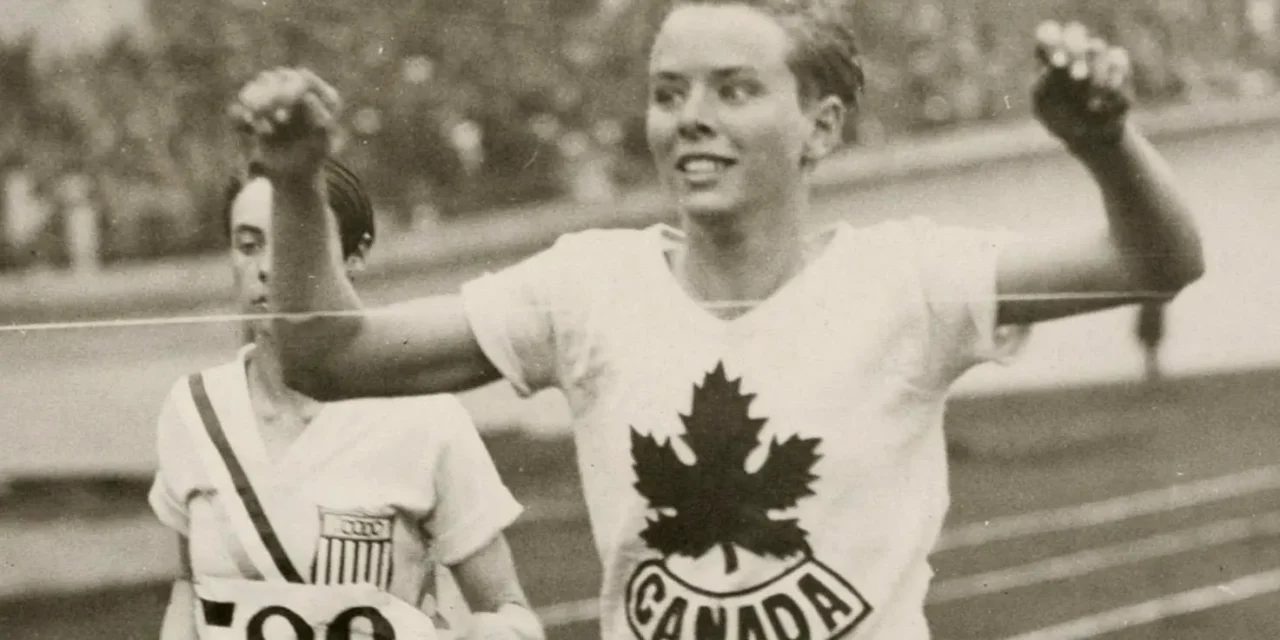
Nearly a century later, one image from the Amsterdam final still appears regularly in books, documentaries and newspaper articles. It shows Canada’s Jean Thompson just beyond the finish line. Her body leans forward, her face is tense and, for a brief moment, she appears completely spent. Behind her, another runner is slowing down, equally exhausted after the effort of the race.
At first glance, the photograph seems to confirm everything generations of readers have been told. Here is visual proof that the race demanded too much. Here is a woman who has pushed herself beyond her limits. The image appears almost self-explanatory, and perhaps that is precisely why it became so influential. Photographs carry a peculiar authority. We tend to trust them more readily than words, believing they show us reality itself rather than a fraction of a second removed from everything that happened before and after.
But photographs never tell the whole story. They freeze a single instant while removing everything that gives that instant meaning. Jean Thompson was photographed immediately after completing an Olympic 800 metres at close to maximum effort. The camera did not record how she had run the race, how quickly she recovered or what happened a few moments later. It certainly did not record the performances of the other finalists, the new world record or the fact that all nine women completed the race. Those details disappeared the moment the shutter closed.
The image became famous because it appeared to illustrate a conclusion that many people had already reached before the race began. Women, critics argued, lacked the endurance for serious middle-distance running. A photograph of an exhausted athlete therefore became more than a photograph. It became confirmation.
What the camera did not see
Modern viewers often assume that the controversy surrounding the 800 metres emerged naturally from what happened on the track. The surviving evidence suggests something rather different. Contemporary film footage shows athletes slowing down, bending over and sitting on the track after an exceptionally demanding race, behaviour familiar to anyone who has watched elite athletics, then or now. It does not show the widespread medical emergency described in many newspaper reports, nor does it support later claims that several women had been unable to finish.
The written accounts drifted even further from reality. Some newspapers reported that five runners had collapsed. Others claimed that several competitors had abandoned the race altogether. One widely circulated version insisted there had been eleven starters, despite the official results recording only nine finalists. Numbers changed from publication to publication, details became increasingly dramatic and, with each retelling, the distinction between observation and interpretation grew less clear.
The athletes themselves were rarely asked whether these descriptions reflected what had actually happened. Florence MacDonald, one of the finalists, would later dismiss the collapse story altogether, recalling that the runners recovered quickly and that the newspaper reports bore little resemblance to her own memory of the race. By then, however, the narrative had acquired a life of its own. It had been repeated often enough to sound like established fact.
How myths are made
Historical myths rarely begin with outright invention. More often, they emerge when a real event is filtered through expectations that already exist. The women in Amsterdam really were exhausted. They had just raced at world-record pace over one of the most demanding distances in athletics. That much was undeniable. What followed was interpretation.
To many observers in 1928, visible fatigue meant something fundamentally different depending on who experienced it. A man lying on the infield after an Olympic race demonstrated courage, determination and the willingness to sacrifice everything for victory. A woman displaying the same exhaustion could be presented as evidence that she had attempted something her body was never meant to do. The physical reality was identical. Only its meaning changed.
That distinction is easy to overlook because it was rarely stated explicitly. Newspapers seldom wrote that women should be excluded simply because they were women. Instead, the argument was framed as concern for their health, their dignity or their future wellbeing. The language sounded protective. The consequences were restrictive.
The photograph of Jean Thompson did not create those beliefs. It simply gave them an image that could be reproduced again and again, long after the race itself had faded from memory.
What happened next was even more remarkable than the race itself. Instead of celebrating the athletes who had pushed the boundaries of endurance, officials declared the event proof that women were physically incapable of running such a distance. The decision was swift: the women’s 800 metres disappeared from the Olympic programme. It would not return until the Rome Games in 1960. For thirty-two years, an entire generation of female middle-distance runners was denied the opportunity to compete on the world’s biggest sporting stage. Lina Radke, the first Olympic champion over 800 metres, never had the chance to defend her title. Kinue Hitomi, who had fought her to the finish and won silver, never had the opportunity to try again. Their race should have opened a new chapter in women’s athletics. Instead, it closed one before it had barely begun. Because the wrong story was told.
The Historical Record
What happened in Amsterdam in 1928?
- The women’s 800 metres was held at the Olympic Games for the first time on 2 August 1928.
- Nine athletes competed in the final. All nine finished the race.
- Lina Radke won in a new world record of 2:16.8.
- Kinue Hitomi won silver. Inga Gentzel won bronze.
- Several runners showed signs of exhaustion after the finish, as was common in middle-distance races of the era.
- Newspapers exaggerated these scenes and portrayed the race as evidence that women were physically unsuited to the distance.
- The women’s 800 metres disappeared from the Olympic programme for the next 32 years.
- It returned at the Rome Olympic Games in 1960.
- Lina Radke never had the chance to defend her Olympic title. Kinue Hitomi never had the chance to fight for it again.
Women in This Chapter
- Alice Milliat: Founder of the Fédération Sportive Féminine Internationale, whose work helped force the Olympic movement to include women’s athletics.
- Lina Radke: Olympic champion and world record holder in the first women’s 800 metres.
- Kinue Hitomi: Silver medallist and the first Japanese woman to win an Olympic medal.
- Inga Gentzel: Bronze medallist and former 800-metre world record holder.
- Jean “Jenny” Thompson: Finished fourth. A photograph of her after the race became one of the defining images of the controversy.
- Florence MacDonald: American finalist who later rejected claims of a mass collapse after the race.
Why This Story Matters
The 1928 Olympic 800 metres was more than a race. It showed how existing prejudice could turn ordinary exhaustion into supposed proof that women were unfit for competition. A world record became a warning, an extraordinary performance became a scandal, and an entire generation of female middle-distance runners lost their Olympic stage.
Not because the women couldn’t run. Because the wrong story was told.
Sources
- World Athletics Heritage – Milestones in Women’s Athletics Competition
- World Athletics – Centenary of the First Women’s Olympiad
- Olympedia – Women’s 800 Metres, Amsterdam 1928
- Olympedia – Athletics at the 1928 Olympic Games
- Journal of Olympic History – The Women’s 800 Metres Track Event Post 1928 (Ian Jobling)
- Library and Archives Canada – Jean Thompson at the 1928 Olympic Games
- Japan Journal of Physical Education – Correspondence between the FSFI and the IOC
Pic Source: BiblioArchives / LibraryArchives, CC BY 2.0 <https://creativecommons.org/licenses/by/2.0>, via Wikimedia Commons