


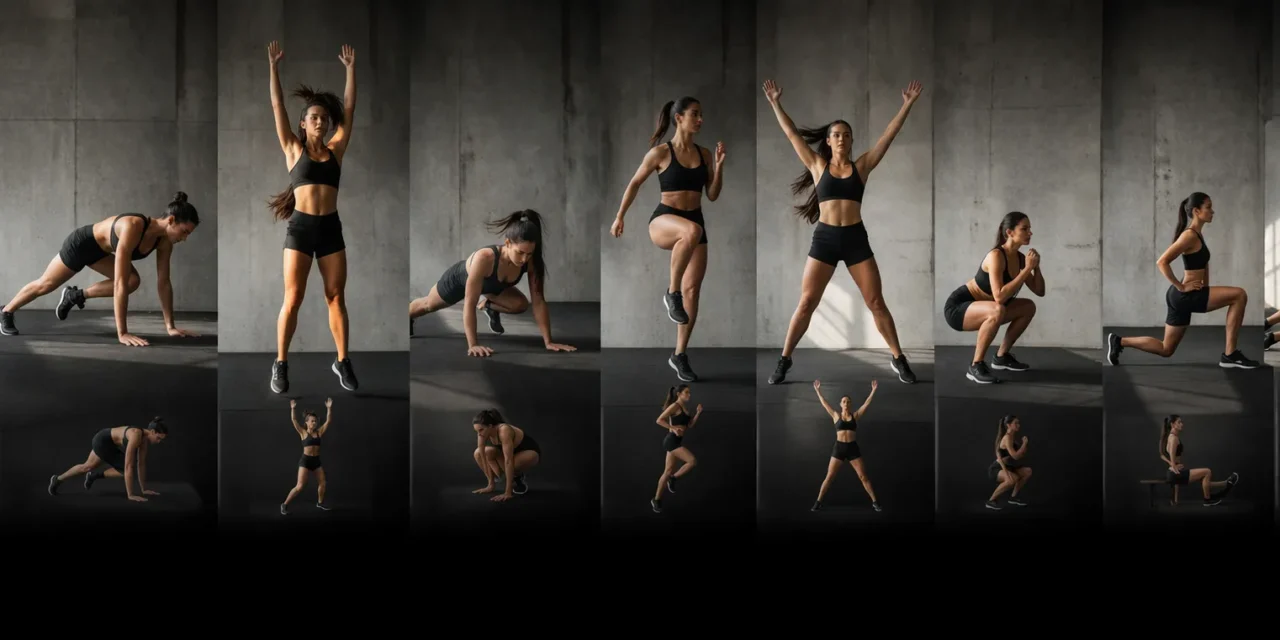
If you want a body that doesn’t just look good but actually works in real life, functional bodyweight training is your foundation. These exercises train natural movement patterns—pushing, pulling, stabilizing, jumping—so your strength carries over into sports, everyday life, and long-term health. And here’s the key: this isn’t just about “legs” or “core.” It’s about understanding which muscles are doing what—and why that matters.
1. Squat
The squat primarily trains your quadriceps, the muscles at the front of your thighs that are responsible for extending your knees and allowing you to stand up from a bent position. At the same time, your glutes—the largest and most powerful muscles in your body—drive the movement by extending your hips and generating force, especially when rising out of the squat. Supporting these are the hamstrings, located at the back of your thighs, which help stabilize your legs and control the movement as you lower and lift your body.
Throughout the entire exercise, your core—including your abdominal and lower back muscles—works continuously to stabilize your spine and keep your upper body upright. This coordination between lower body strength and core stability is what makes the squat such a fundamental full-body movement, closely reflecting how you move in both sports and everyday life.
In sports, these muscles generate force—whether you sprint, jump, or push off the ground. Stronger legs mean more power and less injury risk.
In everyday life, squats are essential for sitting, standing, and lifting. As you age, maintaining this strength is key to staying independent and preventing falls.
- Helpful for sports: Running, cycling, skiing, football
- Health benefits: Lower-body strength, joint stability, improved metabolism
- Everyday & aging support: Sitting down, standing up, climbing stairs safely
2. Push-up
Push-ups primarily work your pectoralis major (chest), the large muscle responsible for pushing movements and bringing your arms toward the center of your body. Supporting this movement are the triceps, which extend your elbows and generate the force needed to push your body away from the ground, as well as the deltoids (shoulders), which stabilize and guide the motion to keep it controlled and aligned.
At the same time, your core muscles—including the abdominals and lower back—are constantly engaged to hold your body in a straight line. This stabilization prevents your hips from dropping or your back from arching, turning the push-up into a true full-body exercise rather than isolating just the upper body. In addition, smaller stabilizing muscles around your shoulders and shoulder blades are activated to support joint stability and maintain proper movement patterns, which contributes to overall shoulder health and reduces the risk of injury.
In sports, pushing strength is critical for movements like swimming strokes or striking. It builds controlled, functional upper-body power.
In daily life, this strength helps you push objects, get up from the floor, or catch yourself during a fall—especially important as you get older.
- Helpful for sports: Swimming, tennis, martial arts, CrossFit
- Health benefits: Upper-body strength, shoulder stability, core engagement
- Everyday & aging support: Pushing movements, fall prevention, upper-body resilience
3. Sit-up
The sit-up primarily targets your rectus abdominis, the front abdominal muscle responsible for bending your spine and bringing your upper body toward your hips. This is the muscle most associated with visible “abs,” but more importantly, it plays a key role in controlling and stabilizing your torso during movement. Supporting this action are the hip flexors, a group of muscles that connect your lower spine and pelvis to your thighs and are responsible for lifting your legs and bending at the hips.
During the sit-up, these muscles work together to raise your upper body from the floor, while your deeper core stabilizers help maintain control and alignment. This coordinated effort not only builds strength but also improves your ability to control movements involving your torso and hips—an essential function for both athletic performance and everyday activities.
In sports, these muscles transfer force between upper and lower body—crucial for rotation and explosive movements.
In everyday life, a strong core supports your spine, improves posture, and reduces lower back strain.
- Helpful for sports: Boxing, gymnastics, soccer
- Health benefits: Core strength, posture improvement, back support
- Everyday & aging support: Getting out of bed, maintaining posture
4. Plank
The plank primarily strengthens your transverse abdominis, a deep core muscle that acts like a natural corset by stabilizing your spine and maintaining internal pressure in your abdomen. Supporting this are the obliques, located along the sides of your torso, which help control rotation and prevent unwanted twisting or collapsing of your body during the hold. At the same time, the erector spinae—a group of muscles running along your spine—work to keep your back aligned and upright.
What makes the plank especially effective is that all of these muscles work together to resist movement rather than create it. This kind of isometric stabilization is essential for protecting your spine, improving posture, and creating a strong, stable foundation for almost every movement you perform, both in sports and in everyday life.
In sports, these muscles stabilize your body under load, preventing energy loss and improving efficiency.
In daily life, they support posture and balance—critical for avoiding falls and back pain as you age.
- Helpful for sports: Yoga, surfing, climbing, running
- Health benefits: Core stability, spinal protection, improved posture
- Everyday & aging support: Balance, stability, fall prevention
5. Lunges
Lunges train your glutes, which are responsible for powerful hip extension and driving you forward, as well as your quadriceps, the muscles at the front of your thighs that extend your knees and support you as you rise out of the movement. At the same time, your hamstrings assist in stabilizing your legs and controlling the lowering phase, helping you move smoothly and with control.
What makes lunges particularly effective is the strong involvement of smaller stabilizing muscles around your hips, knees, and ankles. These muscles work continuously to keep your joints aligned and balanced as you step forward or backward. This not only builds strength but also improves coordination and joint stability, making lunges a highly functional exercise that closely reflects real-life movement patterns.
In sports, these stabilizers allow you to move dynamically—changing direction, accelerating, and decelerating safely.
In everyday life, they improve balance and coordination, helping you walk safely—even on uneven ground.
- Helpful for sports: Running, hiking, tennis, basketball
- Health benefits: Balance, coordination, injury prevention
- Everyday & aging support: Stable walking, safer movement, fall prevention
6. Glute Bridge
The glute bridge primarily activates your gluteus maximus, the largest and most powerful muscle in your body, which is responsible for extending your hips and generating force whenever you stand up, walk, or run. Supporting this movement are the hamstrings, located at the back of your thighs, which assist in hip extension and help control the movement as you lift and lower your hips.
At the same time, your lower back muscles, particularly those along the spine, work to stabilize your pelvis and maintain proper alignment throughout the exercise. This coordinated activation of the posterior chain ensures that your hips move efficiently while your spine remains supported, making the glute bridge an important exercise for improving posture, reducing strain on the lower back, and restoring balance in muscles that are often weakened by prolonged sitting.
In sports, strong glutes generate power and protect your lower back from overload.
In daily life, this reduces the negative effects of prolonged sitting and helps maintain healthy posture.
- Helpful for sports: Sprinting, weightlifting, cycling
- Health benefits: Reduced back pain, improved hip strength, better posture
- Everyday & aging support: Safer lifting, less strain on the lower back
7. Mountain Climbers
Mountain climbers train your core, which works continuously to stabilize your torso and keep your body aligned while your legs move dynamically. At the same time, your shoulders support your upper body and maintain stability through the arms, while your hip flexors are responsible for actively driving your knees forward and upward with each step.
In addition, this exercise places a strong demand on your cardiovascular system, meaning your heart, lungs, and blood vessels have to work harder to supply oxygen to your muscles. As a result, mountain climbers not only build muscular strength and coordination, but also improve endurance, increase heart rate, and enhance your overall ability to sustain physical effort over time.
This improves your ability to deliver oxygen to your muscles, increasing endurance and overall energy levels.
In daily life, a strong cardiovascular system supports heart health, stamina, and faster recovery.
- Helpful for sports: HIIT, boxing, functional training
- Health benefits: Cardio fitness, core strength, endurance
- Everyday & aging support: Energy levels, coordination, heart health
8. Burpees
Burpees combine legs, arms, chest, core, and cardiovascular system into one continuous, coordinated movement that challenges your entire body at once. Your legs generate power as you jump and stand up explosively, while your chest, arms, and shoulders work during the push-up phase to control your body as you lower to and press away from the ground. Throughout the movement, your core stabilizes your torso, ensuring that each phase transitions smoothly and efficiently.
At the same time, the dynamic and repetitive nature of burpees places a high demand on your cardiovascular system, requiring your heart and lungs to rapidly supply oxygen to your working muscles. This combination of strength, coordination, and endurance makes burpees a highly effective full-body exercise that not only builds muscular fitness but also significantly improves your overall conditioning and resilience.
They train your body to move efficiently under fatigue—something most sports demand.
In real life, they improve your ability to get up from the ground quickly and safely—a key skill for maintaining independence.
- Helpful for sports: CrossFit, military training, team sports
- Health benefits: Full-body strength, endurance, coordination
- Everyday & aging support: Getting up safely, functional strength
9. Jumping Jacks
Jumping jacks engage your calves, which help you push off the ground and absorb impact as you land, while your shoulders control the upward and downward movement of your arms. At the same time, your body has to coordinate the simultaneous motion of arms and legs, which improves overall coordination and rhythm.
In addition, the continuous jumping movement activates your cardiovascular system, meaning your heart and lungs work harder to deliver oxygen to your muscles. This increases your heart rate, improves circulation, and helps build endurance, making jumping jacks a simple but effective exercise for warming up the body and supporting overall fitness.
In sports, they help prepare your body and improve movement efficiency.
In everyday life, they support circulation and overall mobility—important for staying active as you age.
- Helpful for sports: Universal warm-up
- Health benefits: Cardiovascular health, coordination
- Everyday & aging support: Mobility, circulation, general fitness
10. High Knees
High knees primarily target your hip flexors, the muscles responsible for lifting your thighs upward and driving your legs forward with speed and control. At the same time, your core works to stabilize your torso and keep your upper body upright, preventing unnecessary movement and ensuring efficient mechanics. Your calves are also actively involved, helping you push off the ground quickly and maintain a fast, rhythmic pace.
Because the movement is performed rapidly and continuously, it places a strong demand on your cardiovascular system, requiring your heart and lungs to deliver oxygen efficiently to your working muscles. This not only improves endurance and stamina but also enhances coordination and running mechanics, making high knees a highly effective exercise for both athletic performance and overall fitness.
In sports, they improve running mechanics and speed by training efficient leg lift and coordination.
In everyday life, they support walking ability and reduce the risk of tripping by maintaining proper movement patterns.
- Helpful for sports: Running, football, athletics
- Health benefits: Cardio fitness, coordination, hip strength
- Everyday & aging support: Walking stability, fall prevention
Train for Life, Not Just for Looks
Every muscle has a purpose, and every movement matters. Your body works as a connected system where muscles, joints, and your nervous system interact. True strength is not just force, but how well your body coordinates, stabilizes, and reacts.
Functional bodyweight exercises train exactly that. They improve movement patterns, strength, balance, and body awareness, making your movements more efficient and reducing strain on joints and connective tissue.
In daily life, this means moving better and safer—whether carrying groceries, getting up, or maintaining good posture. At the same time, functional training boosts cardiovascular fitness, supports your metabolism, and strengthens your body against injuries.
As you age, maintaining strength, coordination, and balance becomes essential for staying independent and preventing falls.
This is what we want to achieve: a body that is not just strong, but reliable, capable, and built for real life.
Be bold. Be Baddazz.