

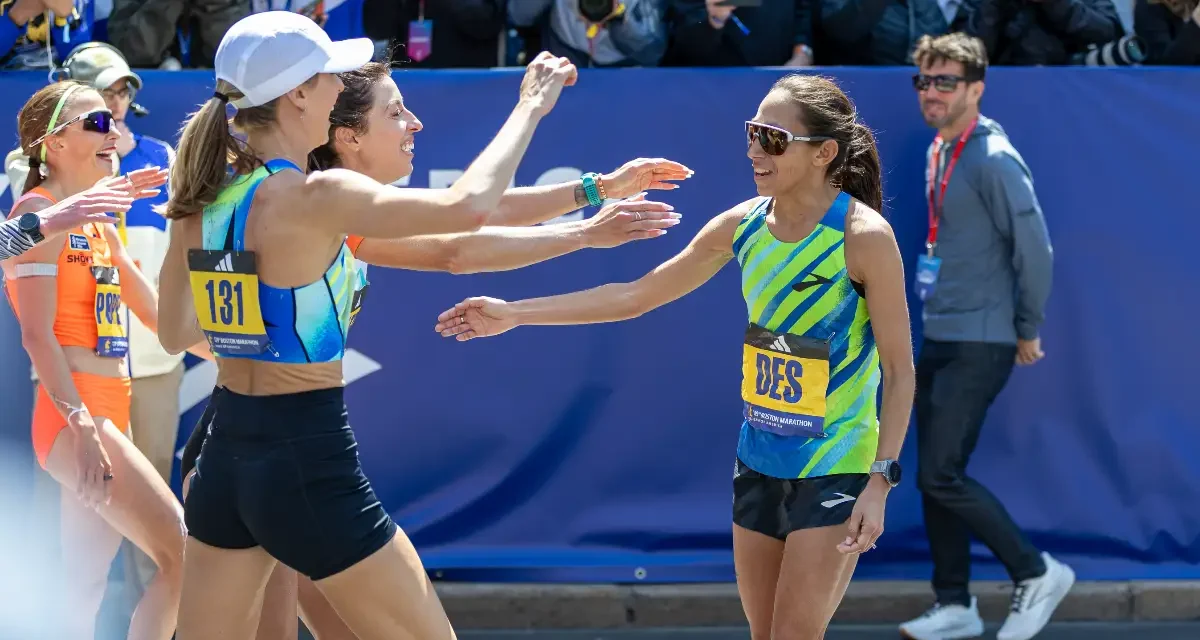
One second separated Jess McClain from defending champion Hellen Obiri at the finish of the 2026 New York City Marathon. This time, McClain was ahead.
Sheila Chepkirui won on November 1 in 2:24:36. McClain passed Obiri in the closing strides to finish second in 2:24:42, with Obiri third in 2:24:43. The New York result gave McClain her highest finish at a World Marathon Major and made her the first American woman on the race’s open-division podium since 2018.
Chepkirui’s victory was the decisive performance. McClain’s second place supplied another compelling story: eight months after following a lead vehicle off course while leading a national championship, she had beaten the defending New York champion to the line.
It would be easy to turn those two finishes into a tidy account of redemption. Between them, though, came a decision more difficult than awarding a shared title or adding names to a team. Officials had to decide how to accommodate runners whose selection race had gone wrong without discarding the results of women who had finished ahead of them.
McClain’s season offers an unusually clear view of what repairing a sporting error can accomplish—and what remains beyond repair even when the athlete subsequently excels.
A championship title without a changed result
On March 1 in Atlanta, McClain was leading the U.S. half-marathon championships when she and two other leaders followed lead vehicles off course. Molly Born crossed the finish line first.
The distinction matters. McClain had a substantial lead before the error, but she had not won the race. There was still running to do. No subsequent ruling could establish exactly how that running would have unfolded, or which athletes would have finished in the qualifying positions had everyone stayed on course.
USATF eventually designated McClain a national co-champion alongside Born. It did not change the finishing order or the recorded times.
That left two different forms of recognition in place. Born remained the first official finisher. McClain shared the championship designation. Describing McClain as the outright Atlanta winner would erase that distinction—and Born’s result.
A shared title addressed recognition. It did not, by itself, settle selection for September’s World Athletics Road Running Championships in Copenhagen. Atlanta was supposed to help determine who would represent the United States. Once the course error had compromised that contest, officials could not simply recover an uncontested set of qualifiers from the finish list.
The runners who had been misdirected had lost the chance to complete the intended race from their positions near the front. Born and the other official leading finishers had results that remained valid. Neither group had caused the problem. Any remedy had to contend with both.
Seven places, two kinds of entry
On March 25, World Athletics announced an exceptional accommodation: the United States could enter seven women in the world half marathon rather than four.
But the expanded entry came with strict limits. Only four women could be designated scoring athletes. The other three could earn world-ranking points, but they could not win championship medals, receive championship prize money or contribute to the team result.
It was a meaningful opportunity, not an equal one. Seven Americans could race in Copenhagen; only four could compete with the full set of championship rewards available.
USATF then named McClain, Emma Grace Hurley, Ednah Kurgat and Weini Kelati as its scoring athletes. Born, Carrie Ellwood and Annie Rodenfels—the first three official finishers in Atlanta—were entered as non-scoring athletes.
This is the uncomfortable part of the resolution. The first three women on the unchanged national championship finish list received world championship entries, but not medal eligibility. McClain, whose disrupted race had prompted a shared championship designation, received a scoring place.
There is a defensible reason not to treat Atlanta’s finishing order as a complete answer: the leaders’ wrong turn had materially altered the competition. Relying on that order alone would have allowed an operational failure to determine selection without accommodation for the athletes directly affected.
There is also a substantial cost to departing from it. Born, Ellwood and Rodenfels were not responsible for the vehicles’ route. Their official performances remained on the books, yet their Copenhagen status carried restrictions that the four scoring runners did not face.
Expanding the field avoided the most absolute choice—admitting one group and excluding the other altogether. It did not eliminate the choice over whose performances could count. Nor should the three additional places be described as though they simply restored full championship opportunities to the three misdirected runners. The eventual roster was more complicated than that.
The remedy therefore needs to be judged in separate parts. It protected participation for seven women. It preserved only four fully eligible entries. And it could not recreate the qualifying race that should have taken place.
What McClain did with her place
In Copenhagen on September 20, Hurley finished fifth, Kelati sixth and McClain seventh. McClain’s 1:06:53 was a personal best. Their three counting finishes earned the United States team silver.
That was a concrete outcome of the selection decision: McClain and Hurley were able to contribute to a world championship medal. McClain had not merely been given a place on a start list; she had produced a seventh-place finish against the world championship field.
The result cannot retrospectively make the selection compromise fair to everyone. Strong performances by the chosen scoring athletes do not tell us what Atlanta’s undisturbed finishing order would have been. Nor do they erase the restricted eligibility of Born, Ellwood and Rodenfels. Copenhagen showed what McClain achieved with the opportunity she received, not that officials had discovered the only possible solution.
There was also more to her season than the dispute. In an October 15 interview with SandyBoy Productions, McClain discussed her full-time work as a nonprofit executive director, racing without an agent and returning to sponsor Brooks.
Those details complicate the familiar outline of an elite runner’s working life. They do not establish that she works because running cannot support her, or that she succeeds because she has another job. What they establish is the arrangement alongside which she was preparing for New York: a full-time executive role, no agent and a renewed sponsorship relationship.
Then came the marathon and a result with no need for an exceptional designation. Chepkirui won. McClain finished six seconds behind her and one second ahead of Obiri. Second place was McClain’s on the finish line and in the official standings.
That is the contrast that gives her season its force. Atlanta required administrators to distinguish a championship title from a finishing position, then a world championship entry from full eligibility. New York required none of those qualifications.
McClain’s podium does not prove that the earlier remedy was fair, or that the wrong turn somehow produced her later success. It shows the limit of what officials could restore. They could give her another opportunity to compete. They could not give back the race she had been leading. In New York, she supplied the result herself.
Pic source: Margot Murphy (Massachusetts Governor’s Press Office)