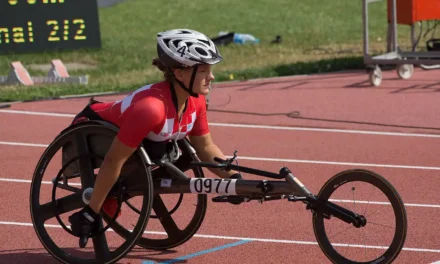



After six days of racing in Balatonfüred, Hungary, Meg Eckert had covered more than 1,000 kilometres. The leading man had covered about 941. According to GOMU’s report of its September 2026 six-day championship, Eckert finished with approximately 1,024 kilometres, more than 80 kilometres ahead of men’s winner Simen Holvik. She had not merely won the women’s division. She had travelled farther than anyone in the race.
The organizer describes Eckert as the first woman to exceed 1,000 kilometres in a six-day race and calls her performance a women’s world record. Its report contains inconsistent distance totals, so a precise record figure and its ratification status should not be treated as settled. The central competitive fact is clearer: Eckert won outright, by a substantial margin. Four months earlier, Rachel Entrekin had won Arizona’s Cocodona 250 outright and set an overall course record. Two different races, two women ahead of every man. It is an inviting sequence for anyone who has heard that women become better endurance athletes once the distance gets long enough.
But that proposition contains several different questions. Can a woman beat an entire mixed field? Demonstrably. Might some characteristics associated with female physiology help under particular endurance conditions? Research offers plausible candidates. Is there a distance beyond which women, as a group, reliably outperform men? That has not been established. Eckert’s achievement deserves a closer look than either a sweeping biological explanation or dismissal as an exception.
Six days are not simply a longer marathon
A fixed-duration race changes the problem. There is no finish line to reach before stopping: athletes accumulate distance until the clock runs out. Moving speed matters, but so does how much of the available time an athlete can keep moving. In an interview-based account published by UltraSignup, Eckert described running roughly 19 to 20 hours a day, taking sleep in two blocks and relying on her crew to help solve problems with food, fluids and nausea.
Those details bring the result into focus. Her distance depended not only on running ability but on repeatedly getting back out after rest, managing what she could eat and drink, and responding when things went wrong. Her support team was part of that performance. None of this establishes that women need less sleep, tolerate nausea better or make better decisions than men. It tells us how this athlete sustained this effort. Turning her account into a general female trait would replace useful reporting with an assumption.
Entrekin’s result provides a different test. Cocodona is a point-to-point trail race over a prescribed distance, rather than a six-day contest to accumulate kilometres. The organizer’s results list her winning time as 56:09:46, ahead of men’s winner Kilian Korth. iRunFar’s race report gives a time two seconds different but confirms the outright win and overall course record. As BADDAZZ explored in Rachel Entrekin: Why Not Me?, her result belongs first to her competitive story. Alongside Eckert’s, it also challenges any assumption that the men’s winner must be the overall winner. What the two results cannot do is isolate why either woman won.
The trouble with the 195-mile claim
The idea of a female endurance crossover has a particularly shareable number attached to it: 195 miles. In its 2020 analysis of ultrarunning results, RunRepeat reported that female finishers were, on average, 0.6% faster than male finishers at distances beyond 195 miles. That finding is frequently treated as a threshold: keep extending a race and, eventually, women become faster.
The distinction between those statements matters. One describes an average among people who finished the races in a dataset. The other proposes a biological rule. A 2024 paper examining claims about women’s ultrarunning advantage identifies a central difficulty: finishers do not necessarily represent starters. If men and women enter races in different proportions, arrive with different levels of experience or drop out at different rates, the finishing averages can reflect that selection as well as running performance.
Imagine two groups whose least-prepared entrants are not equally likely to start, or to finish. Comparing only the survivors cannot tell us what would happen between equally prepared athletes. This is a methodological possibility, not a finding about Eckert’s competitors. There is another mismatch. An average finishing time answers a different question from the fastest performance. The 2024 critique’s comparison of records found men ahead across the ultrarunning records it examined. Those were historical figures checked in January 2024, not a current record inventory. Nevertheless, they show why a claim about average finishers cannot simply become a claim about elite superiority.
Eckert’s six-day victory and RunRepeat’s statistic therefore concern different comparisons: the best athlete in one field, and the average finishers across a collection of races. Neither supplies a universal crossover point. A more revealing attempt to address participation appeared in a 2024 study of a 50-mile and a 100-mile race with roughly equal numbers of male and female starters. In both events, the researchers found no statistically significant sex difference in average finishing time.
Yet the leading athletes told a less uniform story. In the 50-miler, the top ten men were approximately 85 minutes faster than the top ten women. In the 100-miler, the top-ten difference was not statistically significant. That is interesting evidence, not proof of equality. A nonsignificant result means the analysis did not establish a difference; it does not demonstrate that the groups are equivalent. Two races with relatively small fields also cannot settle what happens across ultrarunning. And equal numbers on a starting line do not guarantee equally deep competitive fields, training histories or access to support.
The study does, however, expose how much depends on the question. Are we comparing typical finishers, the top ten, record holders or the winner on a particular weekend? Those comparisons need not produce the same answer.
Do the familiar explanations hold up?
Eckert’s schedule makes fatigue resistance an obvious subject of interest. Her food and nausea problems make fuel use another. The temptation is to connect a proposed female advantage directly to the winner. The evidence does not permit that shortcut. A 2022 review of sex differences in endurance running discussed potential advantages for women involving fatigue resistance, substrate use, the fuels used during exercise, and pacing. These are possible contributors to performance, not a demonstrated explanation for an individual race result.
Fat metabolism is an especially attractive explanation for multiday success: if women draw more heavily on fat during exercise, perhaps they can sustain effort longer. But even the underlying premise needs qualification. A 2026 systematic review and meta-analysis of 36 studies challenged the idea that women consistently oxidize more fat during exercise. Results depended on context, including fitness and exercise modality. More importantly, those exercise measurements were not tests of who wins a six-day race.
Even where a laboratory difference exists, its competitive significance must be demonstrated rather than assumed. A metabolic measurement cannot, by itself, account for sleep, food tolerance, time stopped or the particular opposition an athlete faces. Pacing carries a similar risk of becoming a flattering stereotype: women are supposedly more restrained, men more likely to start too fast. A 2025 analysis covering 56 editions of six 100-mile races found that pacing was not consistently different by sex. That does not mean pacing is irrelevant. It means being female is not a reliable substitute for examining how someone actually raced.
The same discipline applies to fatigue resistance. A potential advantage in a particular task or physiological measure does not establish a net advantage across an entire competition. Nor should findings from ultrarunning be carried over to open-water swimming, cycling or ordinary recreational exercise without evidence specific to those settings. What would explain Eckert’s margin more convincingly? Detailed comparisons of the competitors’ preparation, moving and stopped time, sleep, nutrition, problems and responses would be a start. Even then, one race would remain one race, not an experiment capable of separating sex from every other difference between athletes.
The strongest conclusion is narrower than the popular claim, but still consequential. Women can win mixed ultrarunning fields, including demanding multiday events. Some physiological characteristics may help in particular circumstances. Current evidence does not establish a distance at which women generally become the stronger competitors. In Hungary, nobody needed to resolve that population-level question to determine the winner. Everyone had the same six days. Eckert covered more than 1,000 kilometres; the nearest man covered about 941. That result establishes her superiority in that championship, not the superiority of every woman over every man once a race becomes long enough.