
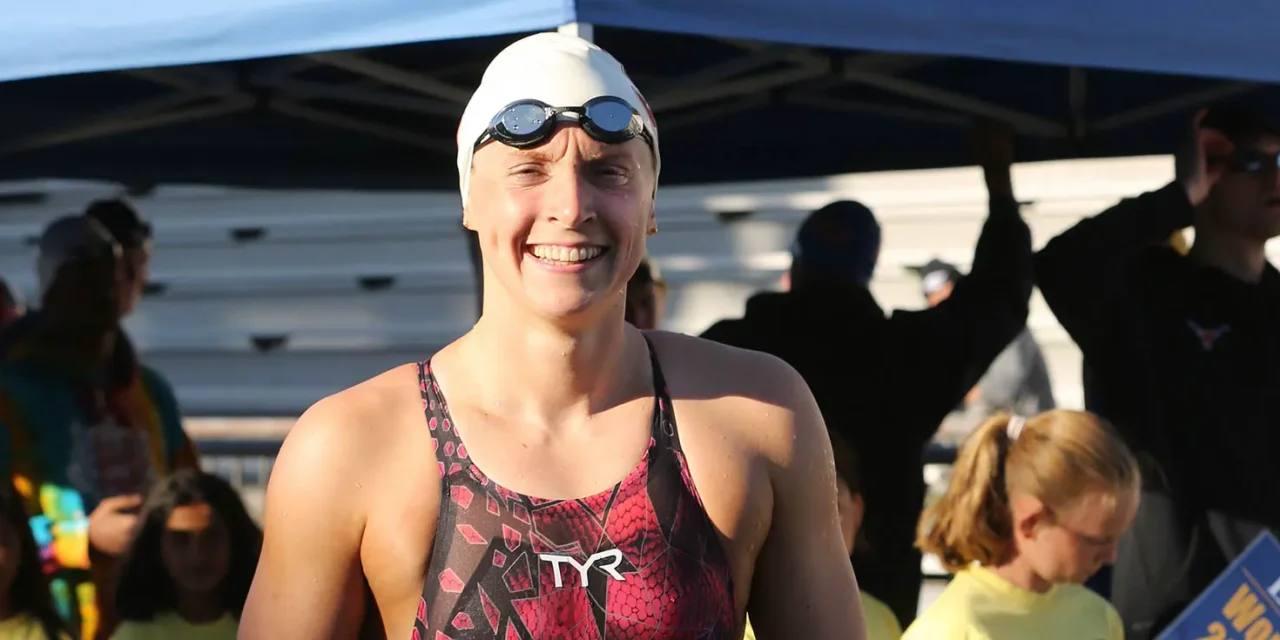
There are world records, and then there is Katie Ledecky. Look at the all-time rankings for the women’s 1500-metre freestyle and something unusual happens. First place: Katie Ledecky. Second: Katie Ledecky. Third, fourth, fifth: Katie Ledecky. Keep going and her name keeps appearing. As of 2026, the ten fastest long-course 1500-metre swims ever recorded all belong to the same woman. She is 29 years old.
Ledecky currently holds the world records in both the 800 and 1500-metre freestyle. She has won nine Olympic gold medals and 23 World Championship titles. She has been Olympic champion across four different Games, from London 2012 to Paris 2024, and in the 800 metres she has won the same individual Olympic event four times in a row. In May 2025, almost thirteen years after becoming Olympic champion at fifteen, she broke her own 800-metre world record again.
That last detail may be the most extraordinary one. Elite sport usually gives us a familiar trajectory. A young athlete emerges, reaches her peak, dominates for a few years and eventually watches the next generation arrive. Ledecky has watched several generations arrive. Some of the swimmers racing her today grew up watching her win Olympic gold. She is still the standard they are chasing. And sometimes, chasing is exactly what it looks like.
Over the years, Ledecky has produced winning margins so large that the familiar image of a swimming race almost disappears. She reaches the wall while the rest of the field is still coming home. At the Rio Olympics in 2016, she won the 800-metre freestyle by more than eleven seconds. In Paris in 2024, she won the 1500 by more than ten. At her strongest distances, the most interesting opponent has often not been the woman in the next lane, but the red world-record line moving across the television screen. The race is behind her.
Just Trying Hard
For all the numbers attached to Katie Ledecky’s name, her own story of how this began is wonderfully unimpressive. She was six years old, swimming 25 metres for the Palisades Porpoises, a summer league team in Maryland. During the race, she repeatedly stopped at the lane line. She adjusted her goggles, wiped her nose and looked around while other children swam past her. Eventually she let go and made her way to the other end. Her father David filmed the race with a camcorder. Afterwards, he asked how it had gone. “Great!” she answered. Then he asked whether she had simply been trying to finish.
“Just trying hard,” Katie replied.
There was no childhood master plan behind what followed. Ledecky joined the team partly because her older brother Michael was swimming and she wanted to join him. Their mother, Mary Gen, had been a competitive swimmer herself, but Katie has repeatedly said that her parents did not push her towards elite sport. She played basketball and soccer, spent summers around the pool with friends and gradually began choosing swimming more seriously. Nine years after that first 25-metre race, she qualified for the London Olympic Games.
She was fifteen, the youngest member of the United States Olympic team, and internationally almost unknown. Her only event was the 800-metre freestyle. In the final she faced Britain’s Rebecca Adlington, the reigning Olympic champion and world record holder, in front of a home crowd. Ledecky did not swim like a fifteen-year-old hoping to stay with the favourites. She went to the front. By halfway, she had opened a significant lead and was swimming ahead of world-record pace. The gap continued to grow. She touched the wall in 8:14.63, more than four seconds ahead of silver medallist Mireia Belmonte and just over half a second outside Adlington’s world record.
Katie Ledecky was Olympic champion at fifteen. Usually, that would be the achievement around which an entire sporting career is remembered. For Ledecky, it was the starting point.
When Second Place Is Somewhere Else
The problem with describing Katie Ledecky’s dominance is that normal sporting language stops being particularly useful. She wins races, but so do thousands of elite athletes. She breaks records, but records are broken every season. She wins by large margins, but even that does not quite explain what has been happening in women’s distance swimming for more than a decade.
Perhaps the best place to see it is Kazan in 2015.
Ledecky arrived at the World Championships at eighteen and entered the 200, 400, 800 and 1500-metre freestyle. Those events do not usually belong to the same swimmer. The 200 requires speed and aggression, while the 1500 demands an entirely different kind of pacing and endurance. Ledecky won all four. With the 4 × 200-metre relay, she left Russia with five gold medals. But even those five medals hide what was actually happening in the pool. In the 1500-metre final, New Zealand’s Lauren Boyle swam 15:40.14, a performance fast enough to make her the third-fastest woman in history at the time. It was an extraordinary swim. She finished almost fifteen seconds behind Katie Ledecky.
That may be the strangest feature of Ledecky’s career. Again and again, women have produced performances that should have been the story of the race, only to discover that Ledecky was swimming somewhere else entirely. For several years, the pattern became almost routine. She would take the lead early, settle into a pace nobody else could maintain and gradually remove the other swimmers from the question of who was going to win. World Aquatics later described how she would swim her own race, leaving the field far behind. The drama shifted. Instead of watching the lanes beside her, spectators watched the clock. Then even the clock struggled to keep up.
Ledecky first broke the long-course 800-metre world record in 2013, when she was sixteen. She lowered it repeatedly until she reached 8:04.79 at the Rio Olympics in 2016. For nine years, nobody in the world went faster. Then, in May 2025, somebody finally did. Katie Ledecky. At 28, she swam 8:04.12 and broke the record she had set at nineteen. The teenager who had once established the standard had grown into the veteran who was still capable of moving it.
That is where the usual idea of an athletic peak becomes difficult to apply to her. Ledecky has been at the top long enough for the sport around her to change. Rivals have retired. New champions have emerged. Ariarne Titmus beat her over 400 metres and eventually took the world record Ledecky had once owned. Summer McIntosh arrived as a teenager, became an Olympic champion and began attacking times that had seemed almost unreachable. The field has not stood still while Ledecky dominated it. It has become faster. So has she.
The 800 metres makes this particularly visible. Ledecky has held its long-course world record continuously since 2013. In 2025, McIntosh swam 8:05.07, closer to Ledecky’s record than any other woman had ever been. Lani Pallister was also approaching territory that had once belonged almost exclusively to Ledecky. Suddenly, the race behind her was becoming a race beside her. At the World Championships in Singapore that summer, all three met in the 800-metre final. This time there was no eleven-second gap and no empty water separating Ledecky from the field. McIntosh led with 100 metres remaining. Pallister was still there. For once, Ledecky was not racing a line on a screen. She was racing the women next to her. She took the lead back and won in 8:05.62. Pallister finished 0.36 seconds behind her. It was Ledecky’s seventh consecutive world title in the 800 metres. No swimmer, male or female, had ever won the same event at seven consecutive World Championships.
The result matters, but the timeline matters more.
The first of those titles came in 2013. The seventh came in 2025. Between them lies almost the entire elite career of many athletes, several generations of challengers and an enormous shift in what women are capable of swimming over 800 metres. Katie Ledecky is still there.
Perhaps that is the clearest way to understand her dominance. It is no longer simply about how far ahead she can get. The sport has spent more than a decade getting faster behind her. New swimmers have arrived who can challenge her, beat her and force her into races that look nothing like the lonely victories of her early career. That does not diminish what Ledecky has done. It shows us the scale of it. For thirteen years, women’s distance swimming has been trying to catch Katie Ledecky. It is finally getting close.
The Historical Record
How dominant is Katie Ledecky?
- Katie Ledecky won her first Olympic gold medal in the 800-metre freestyle at London 2012 at the age of fifteen.
- She has won 14 Olympic medals, including nine golds, across four Olympic Games.
- At Paris 2024, she became the first woman to win the same individual swimming event at four consecutive Olympic Games, taking her fourth straight 800-metre freestyle title.
- Her nine Olympic gold medals are the most won by any female swimmer and tie the record for the most Olympic gold medals won by a woman in any sport.
- At the 2015 World Championships in Kazan, she became the first swimmer to win the 200, 400, 800 and 1500-metre freestyle events at a single World Championships.
- By the end of the 2025 World Championships, she had won 23 World Championship gold medals and 30 World Championship medals overall.
- She currently holds the long-course world records in both the 800-metre freestyle, at 8:04.12, and the 1500-metre freestyle, at 15:20.48.
- As of 2026, Ledecky holds the ten fastest long-course 1500-metre freestyle performances ever recorded.
- She graduated from Stanford University in 2020 with a degree in psychology and a minor in political science.
- Ledecky was diagnosed with postural orthostatic tachycardia syndrome (POTS) in 2015. She kept the diagnosis private until discussing it publicly in her memoir, Just Add Water: My Swimming Life, in 2024.
Women in This Chapter
- Katie Ledecky: American swimmer, nine-time Olympic champion, 23-time world champion and current world record holder in the 800 and 1500-metre freestyle.
- Rebecca Adlington: British Olympic champion and world record holder who entered the London 2012 800-metre freestyle as defending champion and finished third behind fifteen-year-old Ledecky.
- Mireia Belmonte: Spanish swimmer who won silver behind Ledecky in the 800-metre freestyle at the London 2012 Olympic Games.
- Summer McIntosh: Canadian Olympic champion and world record holder who represents a new generation challenging the standards Ledecky has set in distance swimming.
- Lani Pallister: Australian distance swimmer who finished just 0.36 seconds behind Ledecky in the 800-metre freestyle final at the 2025 World Championships.
Why This Story Matters
Katie Ledecky’s dominance is difficult to compare with almost anything else in swimming. For more than a decade, she has not simply won races, but repeatedly pushed the standard of what is possible in women’s distance swimming. New generations of exceptional swimmers keep getting faster, and Ledecky keeps giving them something new to chase.
Being the best is extraordinary. Remaining the standard for everyone who comes after you is something else entirely.
Sources
Official Records & Athlete Profiles
- Team USA – Katie Ledecky Profile
- Team USA – Katie Ledecky Becomes the Most Decorated U.S. Female Olympian
- Stanford University – Katie Ledecky, Olympian and Stanford Alumna
Biography, Interviews & Background
- Sports Illustrated – Back to Her Roots: How Katie Ledecky Became So Dominant in the Pool
- SELF – Katie Ledecky on Her First Olympic Games, adapted from Just Add Water
- SELF – Katie Ledecky on Living With POTS
- Katie Ledecky – Just Add Water: My Swimming Life, Simon & Schuster
Pic Source: JD Lasica from Pleasanton, CA, US